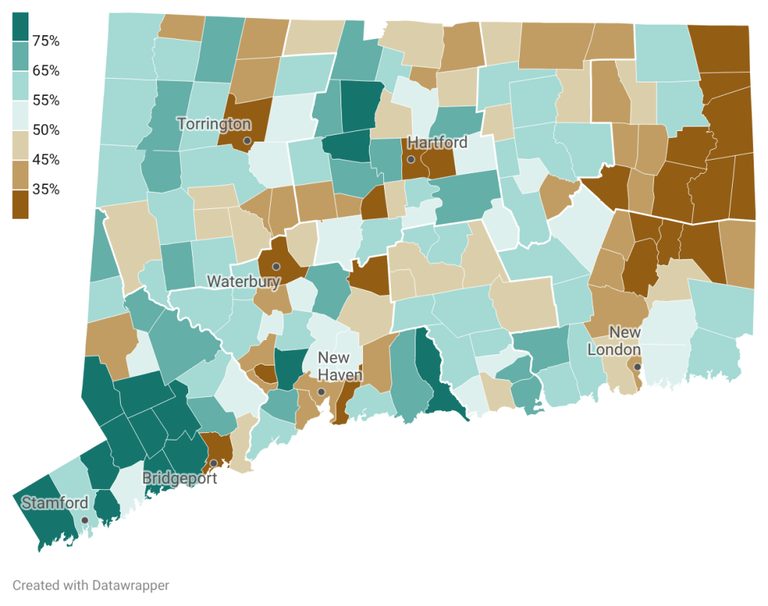
Statewide education officials report that nearly half of Connecticut adults 25 and older now hold a degree beyond high school, according to the 2024 Census. The figure—47%—marks a five‑point increase from 2014, when 42.6% of residents had an associate’s, bachelor’s, master’s or doctorate degree.
Steady gains across degree levels
While the overall share of degree‑holders rose, the breakdown reveals where the growth occurred. Associate’s‑degree attainment held steady, moving only from 7.6% in 2014 to 7.7% in 2024. Bachelor’s‑degree holders grew by an estimated 1.7 percentage points between 2015 and 2024. The biggest jump came from graduate education: master’s and doctorate holders added roughly 2.1 percentage points to the state’s total.
Regional differences persist
Education levels are not uniform across the Constitution State. Data shows the southeast corner—home to towns such as New London, Waterford and Stonington—has a higher proportion of residents with post‑secondary credentials than the northwest region, which includes towns like Litchfield and Torrington.
Sen. Mae Flexer links education to economic stability
Democratic State Senator Mae Flexer, who represents several northeastern towns, said the numbers likely reflect the economic realities of families. “It is very easy to fall off the path when there is financial crisis,” Flexer told reporters. She recalled her own upbringing in Killingly, noting that her mother’s encouragement was crucial in her pursuit of higher education.
Flexer highlighted the state’s community‑college tuition‑free program, which has opened doors for many residents. “I really just didn’t know what I wanted to do, so then I went to the community college because it was free, and I had more money for the last two years,” a local student told the senator.
Looking ahead
From 2023 to 2024 the data showed a slight dip in the share of residents holding any degree other than a bachelor’s, suggesting that while overall attainment is rising, some segments may be experiencing setbacks. Policymakers and educators are watching these trends closely as they shape workforce development and economic planning for the coming years.
With the school year now underway, officials hope that the upward trajectory will continue, especially as more families take advantage of tuition‑free community‑college options and as local businesses seek a more educated workforce.
Original reporting: The Connecticut Mirror — read the source article.