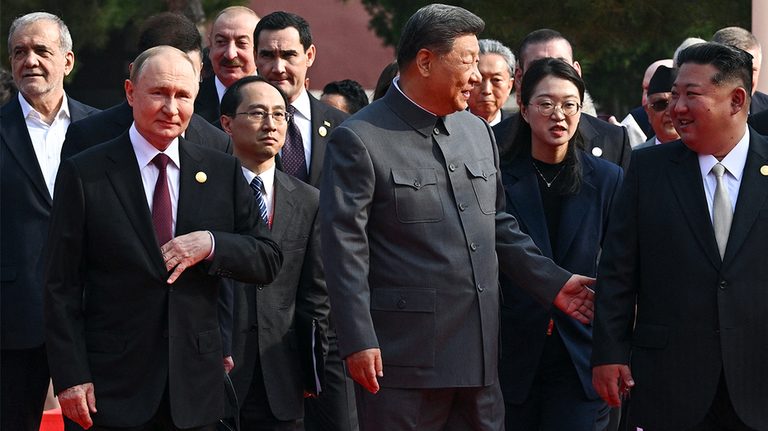
A new book, ‘Axis of Aggressors: Countering the Cooperation of China, Russia, Iran, and North Korea,’ examines the cooperation among these four authoritarian governments across military, economic, cyber, and technology domains. The authors argue that their practical effects are already visible in active conflicts.
Cooperation Among Adversaries
The book’s researchers documented 616 instances of security cooperation among the four governments from January 1, 2019, through December 31, 2025, including arms transfers, weapons development, military exercises, intelligence sharing, and military exchanges. Retired Rear Adm. Mark Montgomery, one of the book’s authors, pointed to North Korean ammunition and troops, Iranian drones and production expertise, and Chinese economic and technological support for Moscow.
Montgomery said the central danger is what the book calls the ‘simultaneity problem.’ ‘We don’t get to handle these with a singularity anymore. We have to handle this with a simultaneity,’ he said. ‘And I don’t think we can handle two problems at once, much less three or four.’
Economic Ties
Economic ties underpin the military cooperation, according to co-author Elaine Dezenski. ‘These four players are bound together more by necessity than they are by a specific trust or shared strategy among them,’ Dezenski said. China purchases discounted Russian and Iranian energy while providing goods, technology, and access to its domestic market.
The relationships remain unequal, with Russia and Iran competing to sell similar products, while China can seek other suppliers. However, Dezenski said those divisions should not obscure the benefits the cooperation provides.
Original reporting: Fox News (HLL/CB) — read the source article.