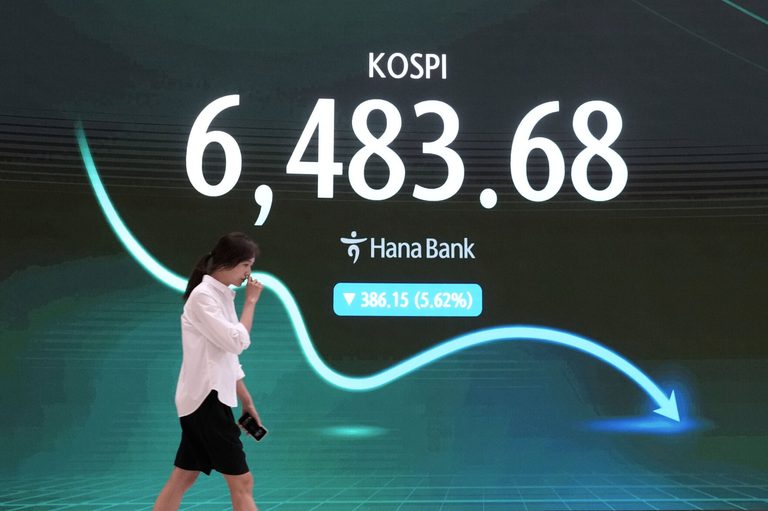
Shares in Asia slipped on Wednesday after Wall Street retreated further from its all‑time high, driven by a renewed sell‑off in artificial‑intelligence‑related stocks and a jump in crude‑oil prices.
South Korea leads regional decline
The South Korean Kospi led the downturn, dropping 5.2% to 6,515.97. Two of the market’s biggest AI beneficiaries, Samsung Electronics and memory‑chip maker SK Hynix, fell 6.9% and 7.9% respectively, underscoring the sector’s volatility.
Other Asian indexes also slide
In Japan, the Nikkei 225 sank 2.6% to 65,703.78. Hong Kong’s Hang Seng lost 0.4% to 25,382.66, while the Shanghai Composite slipped 1.5% to 3,927.70. Taiwan’s Taiex fell 1.4%, and Australia’s S&P/ASX 200 slipped 0.4% to 9,083.70.
Oil price surge adds pressure
Rising oil prices further clouded market sentiment. Brent crude, the international benchmark, rose 0.9% to $91.83 per barrel, and the U.S. benchmark crude gained 1% to $84.88 per barrel. The price swing reflects uncertainty over a potential deal between the United States and Iran that would allow oil tankers to move freely through the Persian Gulf.
Wall Street’s broader pullback
On Tuesday, the S&P 500 fell 0.7% for a third straight modest loss, the Dow Jones Industrial Average dipped 0.2%, and the Nasdaq composite sank 1.3%.
AI‑related stocks under pressure
Shares that have been major winners in the AI boom led the decline. Concerns that AI‑related valuations have risen too quickly and that demand for memory, processors and other data‑center components could wane if AI profitability falls have kept investors cautious. Micron Technology dropped 7%, while chip makers Nvidia and Broadcom fell 2.3% and 3.2% respectively. Despite recent swings, these stocks remain strong performers, with Micron having more than tripled its price this year.
Bond yields rise amid inflation worries
Bond yields have climbed since the conflict began, as higher oil prices push inflation expectations upward. The yield on the 10‑year U.S. Treasury edged down slightly to 4.70% from 4.72% on Monday but remains well above the 3.97% level seen before the Iran‑related tensions. The 30‑year Treasury yield also stayed near its highest level since 2007.
Higher yields make investors less willing to pay premium prices for equities, especially those viewed as expensive. The rise in yields has already lifted the average long‑term U.S. mortgage rate toward its highest level in a year, dampening housing‑sector activity. A recent report noted that homebuilders broke ground on fewer new houses last month than economists had expected.
Currency movements
The U.S. dollar fell to 159.37 Japanese yen from 159.59 yen, while the euro rose modestly to $1.1582 from $1.1574.
AP Business Writer Stan Choe contributed to this report.
Original reporting: KTBS 3 (Shreveport) — read the source article.