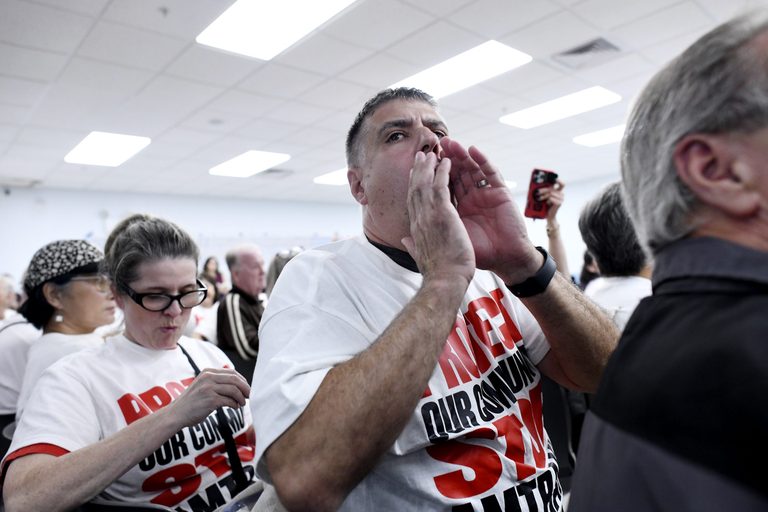
On Thursday night, a packed community meeting in Chicago’s Lower West Side turned into a heated forum over Amtrak’s proposed Midwest Maintenance Facility. Residents of Bridgeport, Chinatown and Armour Square filled the Mid‑America Carpenters Regional Council Facility and the surrounding parking lot, many wearing white shirts that read, “Protect our communities. Stop Amtrak’s rail yard.”
Amtrak’s plan and federal backing
Amtrak representatives outlined a $900 million project to replace the aging maintenance yard near 14th Street with a new two‑mile‑long facility stretching from Cermak Road to West 38th Street, between South Canal Street and South Stewart Avenue. The Federal Railroad Administration granted a categorical exclusion in May, and the federal government awarded up to $572 million for the modernization, with Amtrak required to provide a 20 percent non‑federal match.
Steven Segerlin, an Amtrak spokesperson, said the existing yard is costly to operate and that consolidating maintenance in one building would reduce train delays. He emphasized that the project would not add new trains or alter Amtrak’s service plan, and that major repairs would continue at existing facilities in Brighton Park and Beech Grove, Indiana.
Local concerns and opposition
Community members repeatedly booed and shouted over the presentation. Residents asked about potential noise, air‑quality impacts and the handling of contaminated soil discovered on the site. BFW Environmental Engineering’s Susannah Campbell confirmed metals in the soil and said a soil‑management plan is in development.
Bridgeport resident Catherine Isery questioned whether Amtrak would take additional steps to mitigate noise. Segerlin replied that the design is still evolving and that noise‑reduction measures would be considered. Workplace‑safety expert Dwight Brugh pressed for safeguards against dust‑borne toxins during construction, and Chinatown resident Kim Tee warned that proximity to rail yards can increase respiratory and cardiovascular risks.
“This will kill human beings,” Tee declared, earning applause. Bridgeport resident Gregory Ellis urged Amtrak to release all environmental studies before breaking ground and to give residents a meaningful response period.
Critics label the deal a “shady” real‑estate transaction
Long‑time resident Carmine Giso, who lives about 100 yards from the proposed site, accused Amtrak and developer Canal Edge of providing “zero proper information.” He called the project “a nasty real‑estate deal” and criticized private developer Justin Ishbia’s $125 million contribution, saying he would not force the project on 60‑to‑700 households.
State Rep. Theresa Mah, Cook County Commissioner John Daley, Alderman Nicole Lee (11th) and Alderman Pat Dowell (3rd) attended the meeting. Mah described the process as a “lack of respect” for the community, while Daley argued that residents deserve a full environmental impact review and questioned whether presenters would want the facility next to their own homes.
“Residents in this room are more important than the White Sox,” Daley said. Dowell, whose ward includes part of the site, claimed she had never been contacted about the project and called the three‑year engagement effort “a bunch of crap.”
Link to the White Sox stadium plan
The rail yard discussion is intertwined with a separate proposal by Canal Edge, controlled by White Sox minority owner Justin Ishbia, to develop a new stadium on the current Amtrak yard after the team’s lease at Rate Field ends in 2029. Ishbia holds an option to acquire a controlling interest in the team from Jerry Reinsdorf beginning that year.
While some speakers, such as Nick Desideri and Thomas Haley, voiced support for the project, their remarks were drowned out by opposing chants and questions about the developers’ transparency.
Next steps
Amtrak says construction could begin this fall and last roughly 18 months, pending final negotiations and environmental clearances. Community leaders are calling for a more robust public‑engagement process, full disclosure of all studies, and assurances that noise and soil‑contamination concerns will be addressed before any ground is broken.
Original reporting: Block Club Chicago — read the source article.