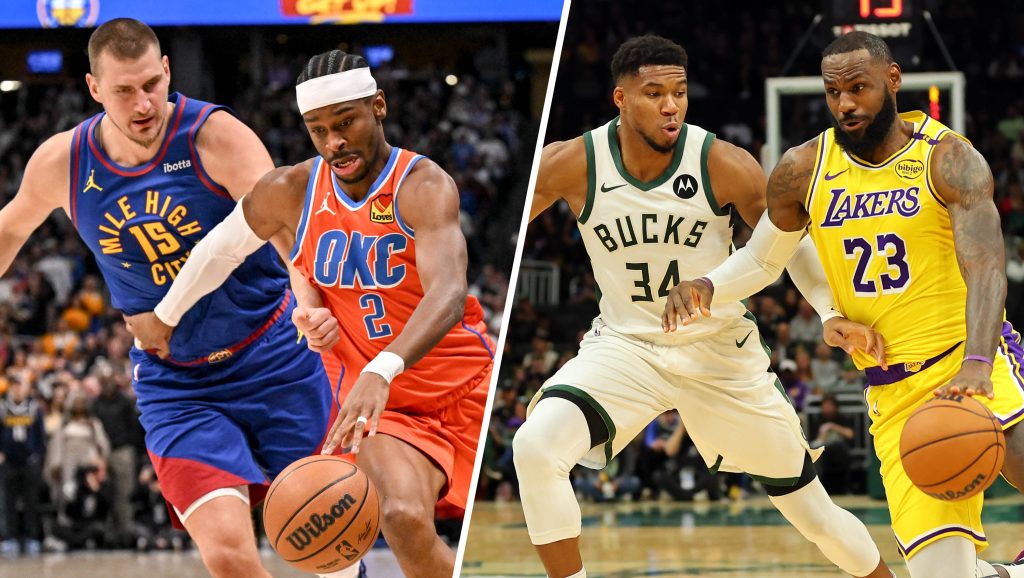
Shai Gilgeous-Alexander of the Oklahoma City Thunder has just joined a rare club by winning back-to-back NBA MVPs, a feat that links him to legends like Bill Russell, Wilt Chamberlain, Kareem Abdul-Jabbar and Michael Jordan. This article walks through every player who has repeated as regular-season MVP, noting the teams, ages and numbers that made each stretch memorable from Boston to Denver and beyond.
Bill Russell was the first to dominate this conversation, actually winning three straight MVPs while helping the Boston Celtics rack up championships. From ages 27 to 29 he averaged about 17.5 points, 23.7 rebounds and 4.1 assists across those seasons, anchoring an era of defensive and rebounding supremacy. That three-peat set a high bar for MVP dominance in the 1960s.
Wilt Chamberlain soon matched Russell’s achievement with his own three straight MVP seasons for the Philadelphia 76ers. Playing at ages 29 through 31, Wilt put up staggering numbers: roughly 27.3 points, 24.2 rebounds and 7.2 assists, often logging absurd minutes. The Sixers won a title in 1967 but felt Russell’s Celtics across that turbulent stretch.
Kareem Abdul-Jabbar pulled off consecutive MVPs after moving to the Los Angeles Lakers, taking home the award at ages 28 and 29. Coming off a championship with Milwaukee, he continued to produce elite scoring and rim protection, averaging around 27.0 points, 15.1 rebounds, 4.5 assists and 3.7 blocks. Those seasons cemented his role as one of the game’s most complete big men.
Moses Malone is unique for winning repeat MVPs while changing jerseys, earning the award with Houston and then Philadelphia. At 27 and 28 he delivered roughly 27.8 points and 15.0 rebounds on average, and though his scoring dipped in the second season, the Sixers were the league’s top team and captured a title. Malone’s back-to-back run proved that dominance could travel with the player.
Larry Bird produced the last three-peat, an incredible run from ages 27 to 29 that blended scoring, passing and rebounding. Across those seasons he averaged near 26.2 points, 10.1 rebounds and 6.7 assists while missing only a handful of games. Boston reached the Finals in each year, coming away with two championships and a legacy of clutch brilliance.
Magic Johnson seized consecutive MVPs at ages 29 and 30 as Kareem’s era wound down and the Lakers leaned into Magic’s playmaking. He averaged about 22.4 points, 12.1 assists and 7.1 rebounds during that stretch, adding another chapter to a career already rich with titles and Finals MVP honors. Those seasons reinforced Magic’s status as a transcendent floor general.
Michael Jordan followed with back-to-back MVPs early in the Bulls dynasty, leading Chicago to championships in those years. At ages 28 and 29 he averaged roughly 30.8 points, 6.2 rebounds and 5.8 assists, a terrifying mix of scoring and competitiveness. Jordan became the first to win regular-season and Finals MVP in consecutive years, a target Shai could aim for in 2026.
Tim Duncan’s two MVPs came during a dominant Spurs stretch at ages 25 and 26, where he delivered remarkably efficient two-way play. Over those seasons he averaged about 24.4 points, 12.8 rebounds, 3.8 assists and 2.7 blocks while missing almost no time. Those campaigns set the stage for more Spurs championships down the road.
Steve Nash stands out as the oldest player to go back-to-back, grabbing MVPs for Phoenix at 31 and 32. Nash averaged roughly 17.2 points and 11.0 assists while orchestrating one of the most exciting offensive systems in help create the fast-paced Suns identity. Even without deep playoff runs, Nash’s impact reshaped how the league thought about tempo.
LeBron James is the only player to have two separate back-to-back stretches, first in Cleveland and then with Miami, showcasing longevity and adaptability. As a young star he averaged around 29.1 points, 7.4 rebounds and 7.9 assists, and later added consecutive regular-season and Finals MVPs at ages 27 and 28. LeBron’s repeated dominance across teams is unmatched in modern eras.
Stephen Curry’s consecutive MVP seasons made him a cultural juggernaut, combining shooting range with efficient scoring and playmaking. He won his first MVP at 27 and then followed with a historic 73-win season at 28, averaging about 26.9 points, 7.2 assists and 4.8 rebounds while converting an astonishing share of threes. Curry’s stretch changed how the league defended and shot the ball.
Giannis Antetokounmpo burst onto the MVP scene with back-to-back awards at ages 24 and 25, pairing freakish physical tools with rapid skill development. Across those seasons he averaged around 28.5 points, 13.0 rebounds and 5.8 assists, and picked up Defensive Player of the Year in 2020. Milwaukee’s playoff disappointments in those years were followed by a championship in 2021, where Giannis took Finals MVP honors.
Nikola Jokic followed Giannis with his own consecutive MVPs at 26 and 27, delivering a unique blend of center passing and scoring for Denver. He averaged close to 26.7 points, 12.3 rebounds and 8.1 assists during the pair of award-winning seasons, later adding a third MVP and multiple finalist nods in a dominant run. Jokic’s playmaking redefined the center position.
Shai Gilgeous-Alexander now joins this elite list after his 2024-25 and 2025-26 MVP seasons, and he’s still only 27. Over these two years he’s averaged about 32.0 points, 6.5 assists and 4.7 rebounds, carrying the Oklahoma City Thunder into the spotlight. If OKC can add another title, Shai could enter even rarer territory alongside Jordan and James as a back-to-back MVP who also earned Finals MVP.