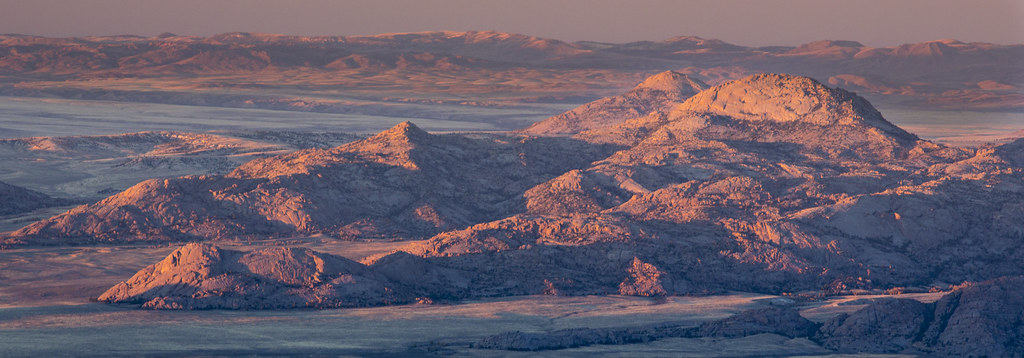
There are moments in travel when a place stops you cold — not because of neon signs or a bustling crowd, but because of something older and quieter and almost impossibly moving. That’s exactly what happened to me the first time I pulled off Wyoming Highway 220 and stood at the base of Independence Rock, about 55 miles southwest of Casper. It’s a place that rewires your sense of time, and once you’ve been, you’ll find yourself telling everyone you know to go.
Independence Rock rises out of the Sweetwater Valley like a great gray whale breaching a sea of sagebrush. It’s roughly 130 feet tall, nearly 1,900 feet long, and almost 850 feet wide — a single, massive dome of granite that pioneers on the Oregon, California, and Mormon Trails once called the “Register of the Desert.” Why? Because emigrant travelers, beginning in the 1840s, carved and painted their names into its surface as they pushed westward. Somewhere between 5,000 and 50,000 signatures are estimated to have once marked this rock. Walking its perimeter, squinting at the faded inscriptions still legible in the stone, you feel the weight of history in your chest in a way no textbook ever quite managed.
Getting here from Casper is half the pleasure. Highway 220 southwest cuts through classic high-desert Wyoming scenery — rolling golden hills, sweeping sky, and the occasional pronghorn antelope watching you curiously from a ridge. Plan for about an hour’s drive, make a thermos of coffee, and watch the landscape open up. The turnoff for Independence Rock is well-marked, and a small, tidy parking area gives you immediate access to the base.
The site itself is managed by Wyoming State Parks and is free to explore on foot. A paved path circles part of the rock and interpretive signs give you rich historical context about the emigrant trails and the people who passed through here. But the real experience is stepping off the path, finding a quiet stretch of granite, and climbing. The rock’s surface is surprisingly climbable — broad, gradual, and textured — and the view from the top on a clear day is genuinely breathtaking. The Sweetwater River glints in the distance, the valley stretches in every direction, and you understand completely why this landmark was a celebrated milestone for westward travelers.
Spring and fall are ideal seasons to visit. Summer brings heat and afternoon thunderstorms, though golden-hour evening light on the granite in July is something special. Bring water, good walking shoes, and a pair of binoculars if you have them — wildlife sightings are common. There are no concessions on site, so pack a lunch and claim a flat rock with a view for your picnic.
Independence Rock is the kind of place that earns its fame honestly. It’s not curated or commercialized. It simply sits there on the Wyoming plain, enormous and patient, carrying two centuries of American ambition in its stone. Day trips from Casper don’t get more rewarding than this.