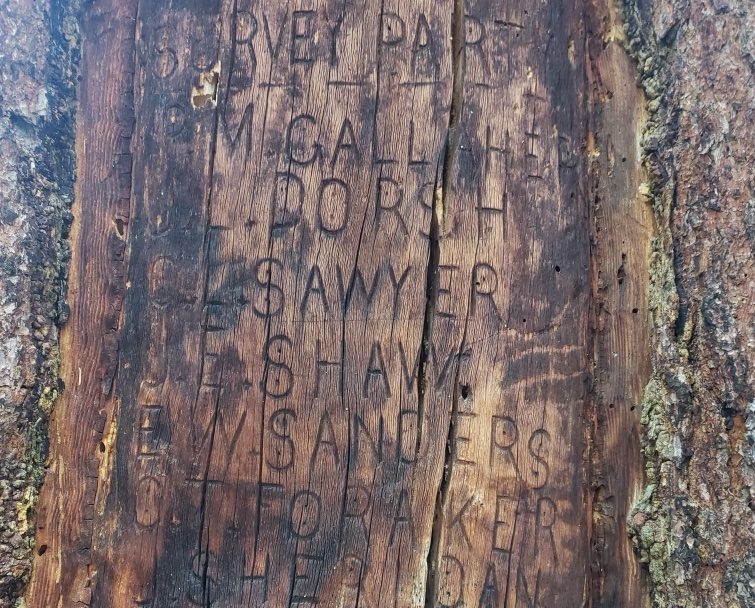
In response to a wave of emails and letters from citizens and wilderness groups, Shoshone National Forest Supervisor Ken Coffin announced a pause on the proposed removal of a historic Engelmann spruce. The tree, located about 28 miles from the nearest trailhead in the Washakie Wilderness, bears the names of surveyors who mapped the Yellowstone Forest Reserve on Oct. 3, 1893.
Public outcry and advocacy concerns
Wilderness Watch, a Missoula‑based organization dedicated to protecting lands under the Wilderness Act, led the opposition. Legislative director Katie Bilodeau urged the public to share their thoughts, emphasizing that the removal would require multiple helicopter landings and mechanical equipment—activities normally prohibited in designated wilderness.
“Wilderness is a place where nature should govern,” Bilodeau told WyoFile. “We shouldn’t be so eager to jump in with our tools, because we can radically alter things pretty quickly.”
Supervisor Coffin’s response
Coffin confirmed he received roughly 200 emails from across the country expressing legitimate concerns. While he personally believes removal could be appropriate, he admitted the agency had not fully consulted the opposing side. “I thought they had a point,” he said.
As a result, the beetle‑killed tree will remain in the remote southern Absaroka Mountains through 2026, and the forest service is exploring a 3‑D scan to create a replica for display instead of extracting the original.
Potential alternatives
Wyoming State Parks, which helped secure a $25,000 allocation for the project in the 2025 legislative session, is open to using the digital model or even a holographic representation. Director Dave Glenn said the scans have turned out well and could serve as a compromise.
Nevertheless, Glenn still favors removal, arguing the historic section could eventually fall and be lost forever. “From our perspective, we’d still like to get the tree out of there, just because it’s so historic,” he explained.
Historical significance
Historian Lawrence Todd noted the tree’s inscription came just 21 years after Yellowstone National Park was established and three years after Wyoming achieved statehood. The 1.2‑million‑acre Yellowstone Forest Reserve, created in 1891, was the precursor to today’s National Forest System.
In 2024, Wyoming lawmakers debated funding to recover the inscribed section for temporary display at the Wyoming State Museum in Cheyenne, with a long‑term goal of moving it to the Buffalo Bill Center of the West in Cody. Although the initial funding attempt failed, the later $25,000 allocation kept the project alive.
Past wilderness advocacy successes
The pause mirrors earlier victories for Wyoming wilderness advocates. In 2017, the Bridger‑Teton National Forest altered plans for a helicopter‑installed Yellowstone River bridge after public pushback, and in 2016, a proposal to stock fishless Mystery Lake in the Teton Wilderness was scrapped following similar concerns.
Bilodeau praised Coffin’s decision, writing, “Y’all saved the survey tree. While trees don’t have as many lives as cats do, they do have a meaningful second life as snags, giving back to the ecosystem that nurtured them.”
Whether the tree will ultimately be removed or preserved through digital means remains to be seen, but the episode underscores the power of local voices in shaping wilderness management decisions.
Original reporting: Oil City News (Casper WY) — read the source article.