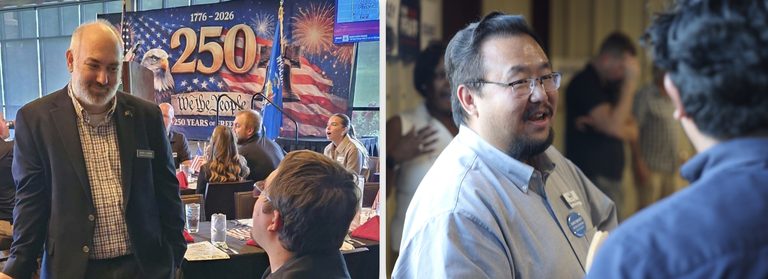
In Wisconsin’s 2026 statewide ballot, the races for secretary of state and state treasurer have moved from the shadows to the campaign trail, giving voters a clear view of each candidate’s priorities.
Secretary of State race
Republican nominee Jay Schroeder argues that the current Wisconsin Elections Commission, created by the Republican‑led Legislature in 2016, should be dissolved and that election administration be placed under the secretary of state’s authority. He says a lack of trust in elections, highlighted by a recent incident in Green Bay where a former clerk sent duplicate ballots, justifies his platform. Schroeder also referenced a claim that voter rolls contain more deceased individuals than living voters, a point that has been widely disputed by election officials.
Democratic candidate JoCasta Zamarripa, a Milwaukee City Council member, counters that the secretary of state’s traditional duties—maintaining public records and the Great Seal—are sufficient. She warns that shifting election control to the office could jeopardize voting safety and confidence. Zamarripa, who served ten years in the state Assembly, also emphasized the role’s potential to support small businesses and immigrant entrepreneurs, describing a vision of the office as a convening hub for Wisconsin’s entrepreneurs.
Green Party candidate Pete Karas of Muskego frames his campaign as a challenge to the two‑party system, urging voters to consider a third‑party option. He proposes modernizing the office by digitizing records and restricting data centers and high‑power transmission lines on public lands overseen by the Board of Commissioners of Public Lands.
State Treasurer race
Incumbent Republican John Leiber seeks re‑election, emphasizing continuity and the ability to provide a Republican perspective on the Board of Commissioners of Public Lands and other state boards. Leiber notes that Republicans previously attempted to eliminate the treasurer’s office via a 2018 constitutional amendment, a measure voters rejected, underscoring public support for the position.
Democratic challenger Yee Leng Xiong argues the treasurer can have influence beyond its constitutional duties, suggesting the office could play a larger role in managing Wisconsin’s unclaimed property program and supporting fiscal transparency.
Context and voter considerations
The secretary of state’s duties in Wisconsin are limited compared with many other states; the office does not oversee elections, a function handled by the Wisconsin Elections Commission. The state treasurer signs checks and administers the unclaimed property program, overseeing roughly 78,000 acres of state land used for school trust funds and timber.
Voters will also note that the current secretary of state, Sarah Godlewski, left the office to run for the Democratic nomination for lieutenant governor, opening the field for new candidates. Godlewski previously served as treasurer and was appointed after former Democratic secretary Doug La Follette resigned in 2023.
Both races feature clear partisan divides and distinct visions for the future of these constitutional offices. As the November ballot approaches, Wisconsin voters will decide whether to expand the secretary of state’s role in elections, maintain the status quo, or embrace a third‑party perspective, while also determining if the treasurer’s office should remain a steady Republican presence or shift toward a broader policy agenda.
Original reporting: Wisconsin Watch — read the source article.