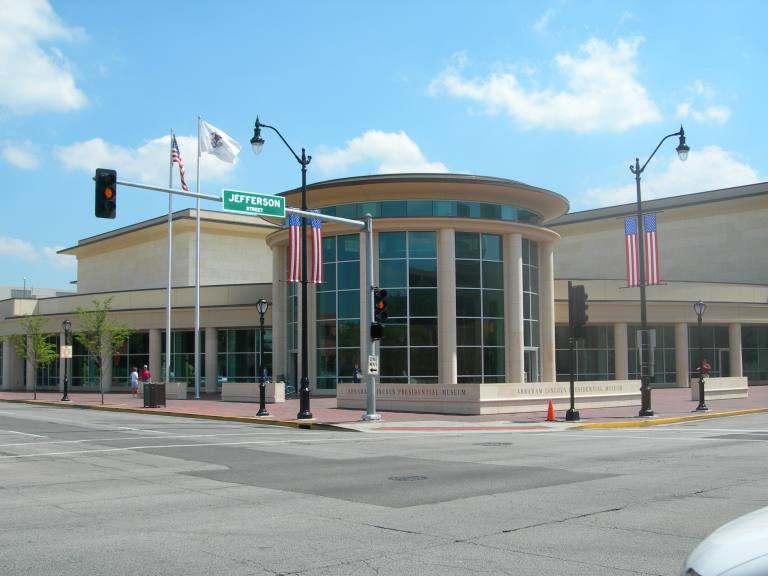
The Abraham Lincoln Presidential Library and Museum sits on Sixth Street in downtown Springfield, and on any given weekday morning it draws a crowd that skews older — retired couples, school groups, the occasional solo traveler who drove in from Decatur just to spend a few hours here.
What most people expect is a dusty archive. What they get is something closer to immersive theater, which either delights or mildly startles visitors who were bracing for glass cases and cardboard labels. The museum’s two main exhibit wings — one covering Lincoln’s early life in Kentucky and Indiana, the other focused on his presidency and assassination — are built around life-sized diorama environments: the cramped log cabin, the frontier store, the White House parlor. Period-accurate props, ambient sound design, dramatic lighting. It does not feel academic. It feels like a production, and a genuinely well-funded one.
The Union Theatre, inside the museum, runs a 3D film called Abraham Lincoln: A New Birth of Freedom. It’s short — around fifteen minutes — and leans theatrical, with special effects built into the seats. Some visitors find it corny. Others walk out looking moved. The Ghosts of the Library show, which runs in a separate presentation space, is quieter and more affecting: projected images of historical figures, re-enacted fragments of Lincoln’s private correspondence. It’s easy to dismiss as a gimmick and harder to forget than expected.
The permanent collection behind all this spectacle is serious. Mary Todd Lincoln’s actual dress. Campaign materials from the 1860 election. Handwritten documents that don’t need any staging to hold attention. The library’s archives — not open to casual visitors, but accessible to researchers — house one of the largest Lincoln-related document collections in the world. The museum is the public-facing side of that scholarship, and the showmanship does not undermine the substance, even if it occasionally overshadows it.
Admission runs $15 for adults, $12 for seniors, $6 for children between five and fifteen. Kids under five are free. The building itself is open daily, and parking is available in the city garage adjacent to the site. Budget two to three hours if the plan is to move through everything without rushing — one if a quick pass through the main galleries is enough.
The museum store is predictably heavy on Lincoln imagery, but it also stocks solid history books, including some published by the library’s own press. The café on the lower level is small and functional — sandwiches, coffee, nothing memorable, but useful if the afternoon runs long.
What makes the place worth revisiting, even for Springfield residents who have already been, is the rotating exhibit program. The library frequently mounts temporary shows that expand well beyond Lincoln — Illinois history, the Civil War era broadly, American political culture. A recent temporary exhibition on Civil War medicine drew specialists from out of state. These shows are included in general admission and are often the most carefully curated spaces in the building.
It is not a subdued experience. The design choices are deliberate, and they favor engagement over reverence. For a city whose entire tourism identity is built around one historical figure, the museum manages to make that figure feel specific and human rather than monumental. That is harder to do than it looks.