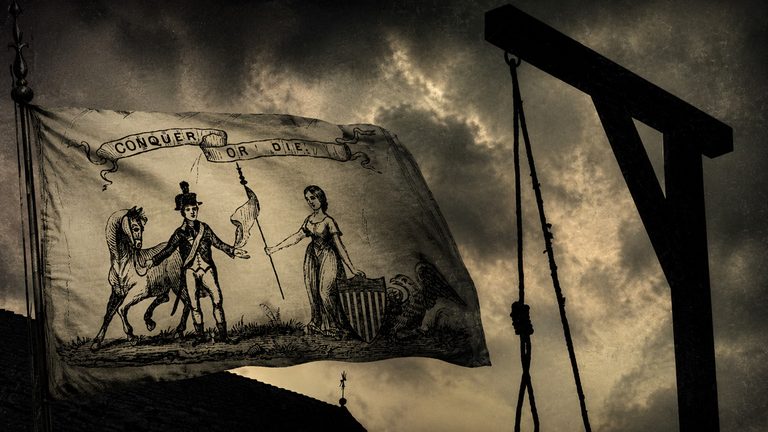
On June 27, 1776, George Washington approved the death sentence for Thomas Hickey, a member of his Life Guard, for sedition and mutiny. Hickey was not a random soldier, but a member of the unit created to protect Washington, the army’s cash, and official papers.
Background
Washington created the Life Guard on March 11, 1776, while he commanded from Cambridge during the siege of Boston. He ordered commanding officers to select four men from each regiment to form his personal guard, according to Mount Vernon.
The unit’s mission was direct: to protect General Washington, the army’s cash, and official papers. Its official name was ‘His Excellency’s Guard,’ or the ‘General’s Guard.’ Soldiers called it ‘The Life Guards,’ ‘The Washington Life Guards,’ or ‘Washington’s Body Guard.’
The Hickey Case
Thomas Hickey was an Irish migrant who had deserted from the British Army and reenlisted in the Continental Army, according to Mount Vernon. He later became tied to Washington’s Life Guard.
The investigation soon reached the Life Guard, including Private Thomas Hickey. The allegation was not vague. According to the June 27 general orders, Isaac Ketchum testified at Hickey’s court-martial that Hickey told him ‘the Army was become damnably corrupted,’ that the British fleet was expected soon, and that Hickey and others were in ‘a Choir to turn against the American Army when the King’s Troops should arrive.’
Hickey’s defense did not deny contact with the Tories. He claimed he did it to cheat them out of money and protect himself if the British defeated the Americans. A court-martial convicted him on June 26. Washington approved the sentence the next day.
Washington did not handle Hickey quietly. He wanted the army to see what would happen to a soldier accused of treacherous contact with the enemy while British forces moved toward New York.
Original reporting: The Dallas Express — read the source article.