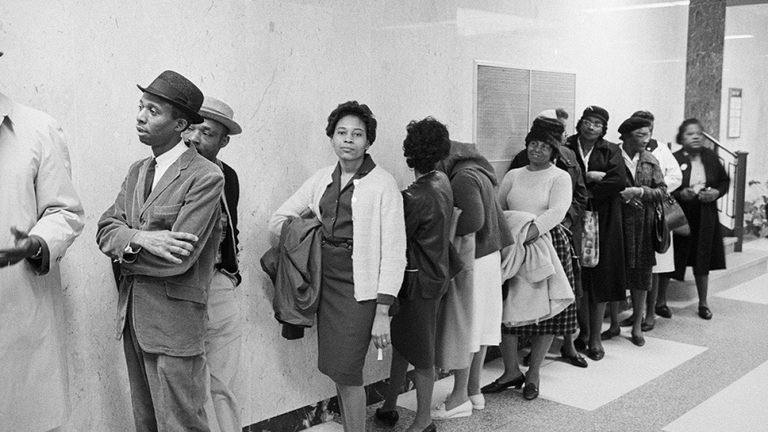
The rural South, once the epicenter of voting rights organizing for Black Americans, is again confronting inequalities in voting rights and fair representation in state, local, and federal government. The Supreme Court has weakened the Voting Rights Act of 1965, a signature accomplishment of the Civil Rights Movement, through recent decisions such as Louisiana v. Callais and Shelby v. Holder.
History of Voting Rights
In 1965, the Voting Rights Act was passed after marches and government violence in Selma, Alabama, turned the nation’s attention to the violence Black voters faced. The law has been reauthorized several times since its passage, but recent years have seen a sharp diversion from protecting voting rights for all Americans.
According to John Cusick, assistant counsel at the NAACP Legal Defense Fund, the Supreme Court’s decision in Louisiana v. Callais gutted Section 2 of the Voting Rights Act, which protected voters of color from racial discrimination in congressional apportionment. This decision, combined with the Shelby v. Holder decision, has led to a surge in restrictive voting laws, including strict photo ID policies and restrictions on mail-in voting.
Impact on Rural Voters
The impact of these decisions is particularly felt in rural areas, where access to reliable transportation and childcare can be limited. James Sutton, director of operations of Foot Soldiers Park, a nonprofit voting rights advocacy organization based in Selma, Alabama, notes that feelings of apathy can be compounded by other challenges, making it extra hard for rural voters to get to the polls.
A data analysis from the Brennan Center for Justice found that the turnout gap between Black and white voters in places previously beholden to the preclearance clause was about five percentage points greater than it would have been if the clause were still in effect.
Original reporting: El Paso News (HLL/CB) — read the source article.