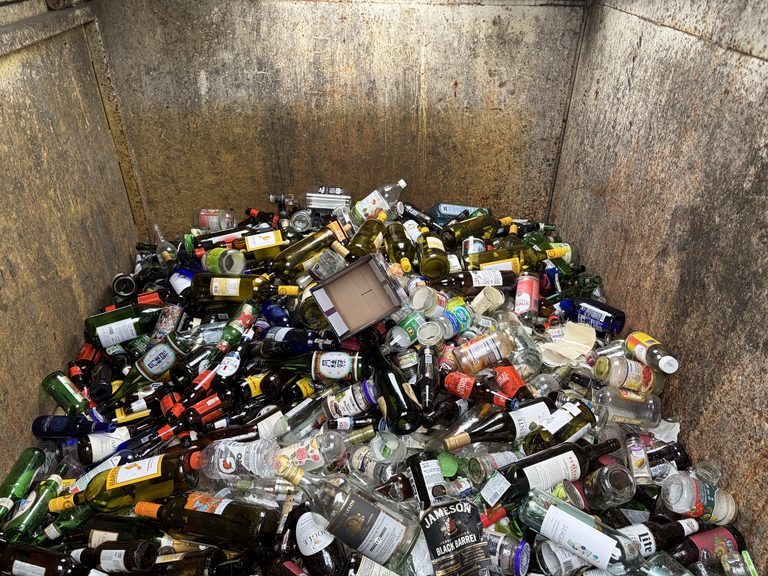
Glass bottles and jars can be recycled indefinitely without losing quality, saving energy, cutting greenhouse‑gas emissions, and preserving raw materials. Yet the Chesapeake Bay watershed lags far behind the European Union, where about 80% of glass containers are reclaimed. In the United States, roughly 30% of glass makes it back into new products, and the three states that share the Bay’s watershed are struggling to improve those numbers.
Virginia’s modest recycling rate and a creative solution
Virginia recycles only about 10% of the glass it collects. The remainder often ends up as cover material for landfills, according to the Virginia Recycling Association. The state has just three plants that actually turn recycled glass into new goods: a Norfolk facility that grinds shards into abrasive grit for industrial cleaning, and two bottle factories owned by O‑I Glass.
Many localities stopped accepting glass curbside because broken pieces can contaminate other recyclables and because glass is heavy and costly to transport without nearby buyers. In response, Fairfax County launched the Purple Can Club in 2019. The program places large purple dumpsters at strategic locations, allowing residents to drop off glass for shipment to a Pennsylvania manufacturer that remelts it into new bottles. Arlington County, the City of Alexandria, and Prince William County have since joined the effort.
Since its inception, the Purple Can Club has diverted more than 51,000 tons of glass and now operates over 50 drop‑off sites across Northern Virginia. Keep Virginia Beautiful, a statewide nonprofit, urges additional localities to invest in processing facilities or dedicated glass bins and supports a state‑wide bottle bill to create a stable market for recycled glass.
Maryland’s challenges and potential gains
Maryland’s recycling assessment (2025) shows a 24% recovery rate for glass. Rural areas of Southern Maryland and the Eastern Shore find glass recycling financially infeasible because the volume collected is too low to justify trucking costs. The state’s three material‑recovery facilities sit along the I‑95 corridor between Baltimore and Washington, D.C., limiting access for many counties.
Anne Arundel County reports a $20 loss per ton of glass processed, underscoring the economic strain. Some counties, like Wicomico, use crushed glass as landfill cover or to seal leachate leaks, even selling it to asphalt producers for “glassphalt.” The Maryland Department of the Environment estimates that a bottle bill combined with producer‑pay waste‑management fees could lift the glass recovery rate to 74%.
Pennsylvania’s mixed picture
Pennsylvania recycles about 23% of the glass placed in curbside bins, according to a 2023 Joint State Government Commission report. Roughly half of the state’s municipalities still accept glass curbside. Broken glass and contamination concerns lead many locales to grind the material for landfill cover, mirroring practices in Virginia and Maryland.
Harrisburg stopped curbside glass collection in 2015, opting for dedicated drop‑off sites instead. Lancaster County continues curbside service, citing the material’s value and the need for strong infrastructure to recycle successfully. Residents can locate permanent or traveling glass‑recycling bins through the Pennsylvania Resources Council.
What families and faith‑based groups can do
Local nonprofits and faith‑based organizations play a vital role. Keep Virginia Beautiful stresses that reduction and reuse should precede recycling. Families can help by rinsing containers, separating glass from other waste, and using the Purple Can Club or similar drop‑off points.
Community leaders argue that a clear, market‑driven approach—shifting recycling costs to producers rather than consumers—aligns with conservative principles of personal responsibility and limited government. By creating a stable demand for recycled glass, states can protect the environment without imposing new taxes on families.
Looking ahead
While the Chesapeake region’s glass‑recycling numbers remain low, the growing network of drop‑off sites, industry partnerships, and legislative proposals offer a path forward. Continued support from local governments, nonprofits, and faith‑based groups can help turn glass waste into a resource, preserving the Bay’s natural beauty for future generations.
Original reporting: Baltimore Fishbowl — read the source article.