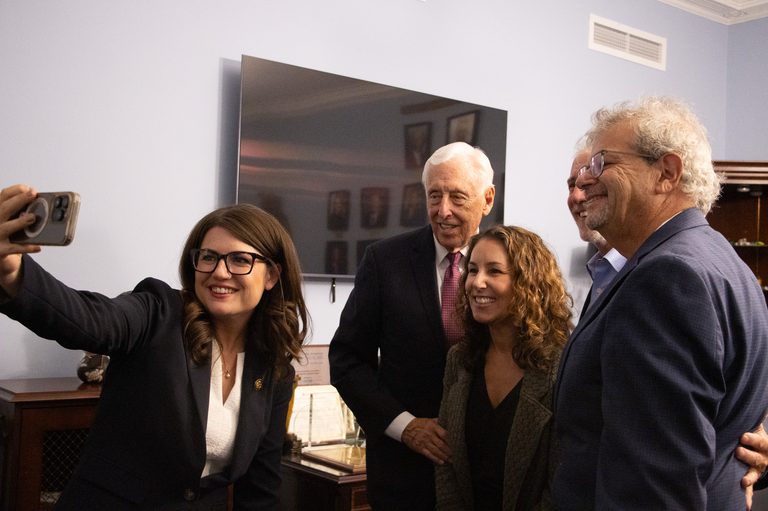
Maryland’s most senior member of the U.S. House, Representative Stony Hoyer, announced that he will retire at the end of this Congress, ending a six‑decade career that began in 1981. In a candid interview on the Maryland Now podcast recorded on Capitol Hill, Hoyer sat down with the newly elected Rep. Sarah Elfreth, a former intern in his office and the youngest member of the Maryland delegation, to discuss how Congress works and why it often falls short.
From mentor to protege
Hoyer, who served as House Democratic leader and whip, recalled his early days in Congress when the nation’s political climate was markedly different. “Bob Michael was a moderate conservative Republican from the middle of the country… He and Tip got along very well. They were friends,” Hoyer said, emphasizing the civility that once defined bipartisan interaction.
Elfreth, who was a toddler when Hoyer helped shepherd the Americans With Disabilities Act in 1990, described her own path from a two‑year‑old learning to walk to an intern in Hoyer’s office, then to the Maryland State Senate, and finally to her 2024 election to the U.S. House.
Psychological versus structural problems
When asked whether structural reforms could revive Congress’s effectiveness, Hoyer was skeptical. “My view is the answer to that is probably no,” he said. “The problem is psychological, not structural.” He argued that a mindset treating deadlines as optional undermines the legislative process. “We have the psychology of December,” Hoyer noted, pointing to the fact that Congress had not met its September 30 budget deadline.
Elfreth agreed that culture plays a role but saw room for structural improvement. She highlighted the lack of organic interaction between Democrats and Republicans, especially outside of committee rooms. “We fly in on Monday, have a few suspension bills, then go home. There’s not a lot of time together for difficult conversations,” she explained.
Erosion of congressional power under President Trump
The conversation turned to the Trump administration’s impact on legislative authority. Both lawmakers agreed that Republicans have been reluctant to serve as a robust check on the executive branch, a dynamic that has further weakened Congress’s ability to shape policy.
Elfreth warned that the current political climate rewards viral moments over substantive work. “The things we prioritize and prize in our politics is strife and division and not the work product,” she said.
Looking ahead
Hoyer’s final weeks in the Capitol will focus on wrapping up constituent services and ensuring a smooth transition for his successor. “I’m retiring, not quitting,” he affirmed, underscoring his continued commitment to Maryland’s residents.
Both Hoyer and Elfreth expressed hope that a renewed emphasis on conscience and judgment, echoing Edmund Burke, could guide future lawmakers. “In the final analysis, what you owe them is your conscience, is your best judgment of what is best for the country,” Hoyer quoted.
Why this matters to Maryland
Hoyer’s departure marks the end of an era for Maryland’s representation in Washington and opens the door for new leadership. Elfreth’s perspective as a young, first‑time congresswoman offers a fresh voice that may reshape how the state’s interests are advocated at the federal level.
Listeners can hear the full conversation on the Maryland Now podcast, produced by Blended Public Affairs and Carper Cre8tive.
Original reporting: Baltimore Fishbowl — read the source article.