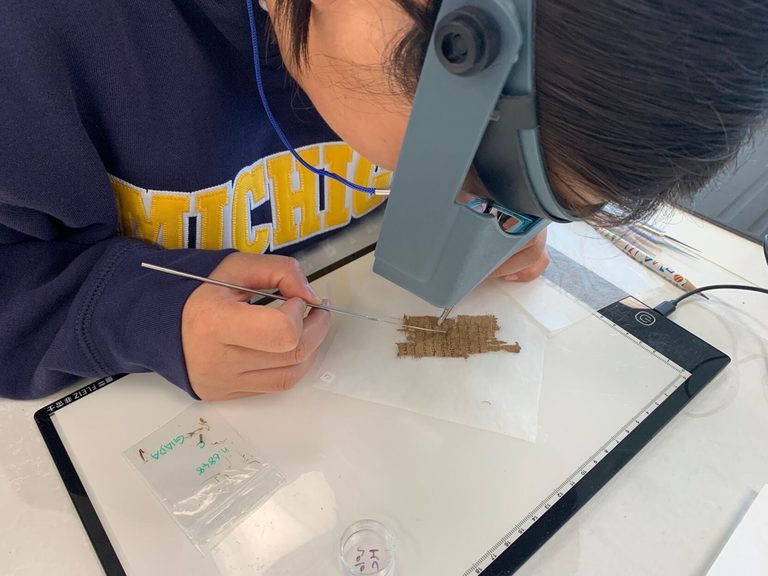
Ann Arbor – The University of Michigan Library opened its doors this summer for a unique ten‑day Papyrus Conservation Summer Seminar, the only program of its kind in the Americas. Nine scholars from the United States, Ireland, Italy, China and Egypt gathered on campus to study the delicate art of preserving ancient papyrus texts.
Hands‑on training in a historic collection
Participants worked directly with the university’s Papyrology Collection, which holds more than 50,000 items dating from 1,000 B.C.E. to 1,000 C.E. The collection includes fragments of Homer’s Odyssey and Iliad, writings of the philosopher Epicurus, and the oldest known copy of the Epistles of Paul. Under the guidance of Marieka Kaye, manager of library preservation services, scholars used precision binocular headband magnifiers and fine hand tools to examine fragile sheets on light boards.
“If you touch this papyrus, you can feel the history,” said Shijin Jiang, a native of China, as she carefully inspected a sheet that had likely not been handled for a century. The seminar emphasized safe handling, controlled moisture treatment, removal of dirt and debris, and slow drying techniques to prevent curling or breakage.
Building the next generation of conservators
“Carrying on this tradition is an incredible responsibility, but it is also incredibly fun and rewarding,” said Kaye. She noted that the program aims to make the work environment “comfortable and not scary,” recognizing that many participants feel apprehensive about handling objects that are thousands of years old.
Giuliano Sidro, curator of the Papyrology Collection, stressed the urgency of training new conservators. “If we don’t train the next generations of conservators, this is a craft that is going to be lost,” he warned.
International collaboration and cultural exchange
The seminar also fostered cross‑cultural connections. Arzak Mohamed, a post‑doctoral fellow from Fayoum, Egypt, and a mother of three, highlighted the program’s potential to bridge continents. “Now I can transfer this information from Michigan to Egypt and even to Australia,” she said, noting her role as a link between three countries.
Other participants included Mauro Castiello, a doctoral student from Milan who translates ancient Greek and Latin, and several scholars who can read Arabic, the language of many Egyptian papyri. Kaye makes a point of including at least one Egyptian participant each session to ensure knowledge returns to the region of origin.
Historical roots and future prospects
The seminar traces its origins to 2012, with sessions held biennially except for a pause during the 2020 pandemic. To date, about 50 students have completed the program. The University of Michigan’s collection grew in part from early 20th‑century expeditions to the ancient site of Karanis, Egypt, led by Latin professor Francis Willey Kelsey, whose vision was that students should study not only books but also the tangible remains of antiquity.
Today, the Kelsey Museum of Archaeology houses a premier assemblage of Greco‑Roman Egyptian artifacts outside of Cairo, offering scholars a rare opportunity to make discoveries “every day, if you just go into the vault, pick out a box and open something up,” Sidro said.
Why the seminar matters to Ann Arbor
Beyond academic enrichment, the program underscores Ann Arbor’s role as a hub for specialized research and cultural preservation. By training international scholars and sharing best practices, the university contributes to the global effort to safeguard humanity’s written heritage while reinforcing the city’s reputation for world‑class education and scholarly collaboration.
Original reporting: KTBS 3 (Shreveport) — read the source article.