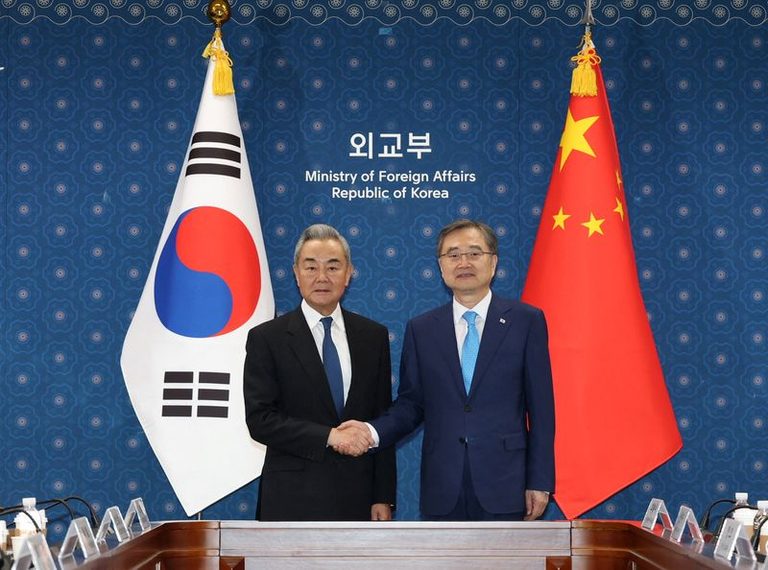
In a meeting held in Seoul on Thursday, China’s Foreign Minister Wang Yi told South Korea’s National Security Adviser Wi Sung‑lac that Beijing hopes Seoul will avoid taking sides in the growing rivalry between China and the United States. Wang said the United States should abandon what he described as a “hostile” policy toward North Korea if the Korean Peninsula is to move toward lasting peace.
Calls for strategic autonomy
Wang emphasized that a “fundamental solution” to the peninsula’s tensions lies in addressing the root causes of the dispute and urging the United States to change its approach toward Pyongyang. He urged South Korea to achieve “genuine strategic autonomy,” refrain from bloc confrontation, and develop relations with both China and the United States in parallel and without contradiction.
U.S. actions raise concerns
The remarks came after former President Donald Trump announced plans to meet North Korean leader Kim Jong Un later this year and claimed the North possesses 57 “very powerful” nuclear weapons. Trump also ordered a reduction in joint U.S.–South Korean military exercises, citing his “very good relationship” with Kim. The United States continues to demand that North Korea denuclearize, a position Pyongyang has consistently rejected.
North Korea’s missile launch
On the same day, Japan’s government and coast guard reported that North Korea fired a suspected ballistic missile toward the sea. While the launch did not directly involve South Korea, it underscored the volatile security environment that Wang said China wants to see resolved through dialogue and trust‑building.
China‑South Korea ties
In separate talks with President Lee Jae Myung, Wang praised the “fully recovered” bilateral relationship and called for a “rational, pragmatic, and positive” policy toward China, describing it as aligned with South Korea’s national interests and the broader trend of the times. He also urged the early completion of second‑stage talks on a free‑trade agreement, noting the need for regional economic integration amid rising global protectionism.
Implications for regional stability
Wang’s statements reflect Beijing’s broader diplomatic strategy of encouraging neighboring countries to maintain balanced foreign policies rather than aligning exclusively with the United States. By urging South Korea to avoid bloc politics, China seeks to reduce the risk of a divided peninsula and to promote a diplomatic environment that could eventually lead to renewed inter‑Korean dialogue.
For South Korean policymakers, the message presents a diplomatic tightrope: navigating U.S. security commitments while preserving constructive ties with China, the region’s largest trading partner. The outcome of these discussions may shape the future of trade, security cooperation, and the overall stability of East Asia.
Original reporting: Appleton, WI News Feed (HLL/CB) — read the source article.