Unitree’s GD01 — a rideable, transformable robot demonstrated by founder Wang Xingxing — is turning heads from Beijing to Shanghai with a demo of a person inside pushing through bricks. This article breaks down what the machine is, how Unitree is positioning the tech, the questions the demo raises about safety and use, and what the GD01 might signal for future robotics and industry plans tied to a Shanghai STAR Market listing.
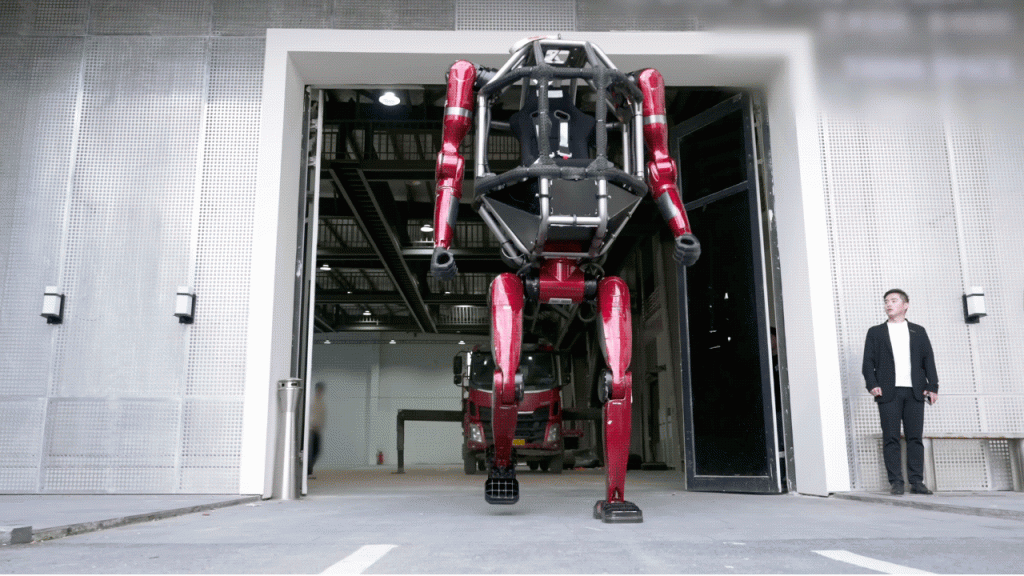
A towering, rideable robot that makes people double-take is exactly what Unitree showed off when it revealed the GD01. The machine can shift between a bipedal stance and a four-legged mode while carrying a person inside, and the brief video of founder Wang Xingxing sitting in the cockpit became an instant attention magnet. That sight of a human inside a walking machine is the kind of tech spectacle that looks cinematic and also a bit unsettling.
Unitree bills the GD01 as a civilian vehicle with a starting price of about $574,000 and an approximate weight of 1,100 pounds with a rider. At that cost it sits in exotic-vehicle territory more than mass-market robotics, which makes it likely to land first in exhibitions, theme parks, research labs, or private collections. The price and size also raise obvious questions about practical utility and regulatory limits.
The demo video focused on showmanship. It shows the GD01 walking forward with a person inside, shoving through a stack of bricks and then shifting into a four-legged posture. That transforming ability is the headline feature: two-legged mode for navigating tighter spaces and a four-legged stance for added stability and balance. The visual theater sells the idea, but the clip provides very little technical detail.
Unitree has not released full specs, so range, battery life, top speed and safety systems remain unknown. Those omissions matter because a moving 1,100-pound machine operating around people is a different class of risk than the small delivery bots already on sidewalks. Without clear safety systems and legal paths for public operation, the GD01 is mostly a showpiece for now rather than a street-ready product.
What makes the GD01 notable is less the robot itself and more the signal it sends about where robotics is headed. Unitree is building an ecosystem that goes beyond one flagship machine, introducing things like UniStore, a downloadable app store for robot motion skills. The focus so far on dance moves, martial arts and spectacle hints at entertainment value first, with practical applications to follow later as the tech matures and scales.
The company has also introduced smaller, more affordable models, including a dual-arm humanoid with a starting price around $3,960, and opened a retail presence in Beijing’s Wangfujing district. At the same time, Unitree is preparing for a public listing on Shanghai’s STAR Market and reportedly aims to raise around $610 million to fund embodied AI research and expand manufacturing. Those moves suggest Unitree wants to be more than a viral demo machine; it is positioning itself as an industrial player in robotics.
Even so, mass production does not equal mainstream adoption. A half-million-dollar rideable robot will likely be confined to niche uses for some time: exhibitions, specialized industrial testing, security demonstrations and wealthy collectors or theme parks. For the typical person, the GD01 is a preview of possibilities rather than an immediate change to daily life.
There are broader technological threads worth watching. The balance, sensing and control systems needed for a rideable, transformable robot could trickle into rescue robotics, warehouse automation, mobility devices and heavy-duty industrial machines. The exact GD01 model may remain rare, but the underlying hardware and software could influence robots that deliver real utility down the road.
Regulation and safety will need to catch up if machines of this scale start operating around people. A walking robot that weighs roughly 1,100 pounds with a person inside is an order of magnitude different from a small rolling delivery unit. Authorities will face new questions about certification, public operation, liability and how to manage such robots in shared spaces.
Watching Unitree’s display, it’s hard not to repeat the spontaneous reaction the clip inspired: “Wait, are they really selling that?” The spectacle also brings another blunt question into focus: “OK, but who is this really for?” Those two lines capture the dual nature of the GD01 as both a marketing triumph and a technology still searching for a clear, practical role.
Unitree’s GD01 is loud, attention-grabbing and a useful hint about robotic ambition, even if it is not a ready-made winner for everyday use. For now, it looks destined to appear at trade shows, theme-park stages and research floors where spectacle and testing intersect. The bigger story is how companies like Unitree are converting eye-catching concepts into tangible products and an industry roadmap that could reshape several sectors in the years ahead.