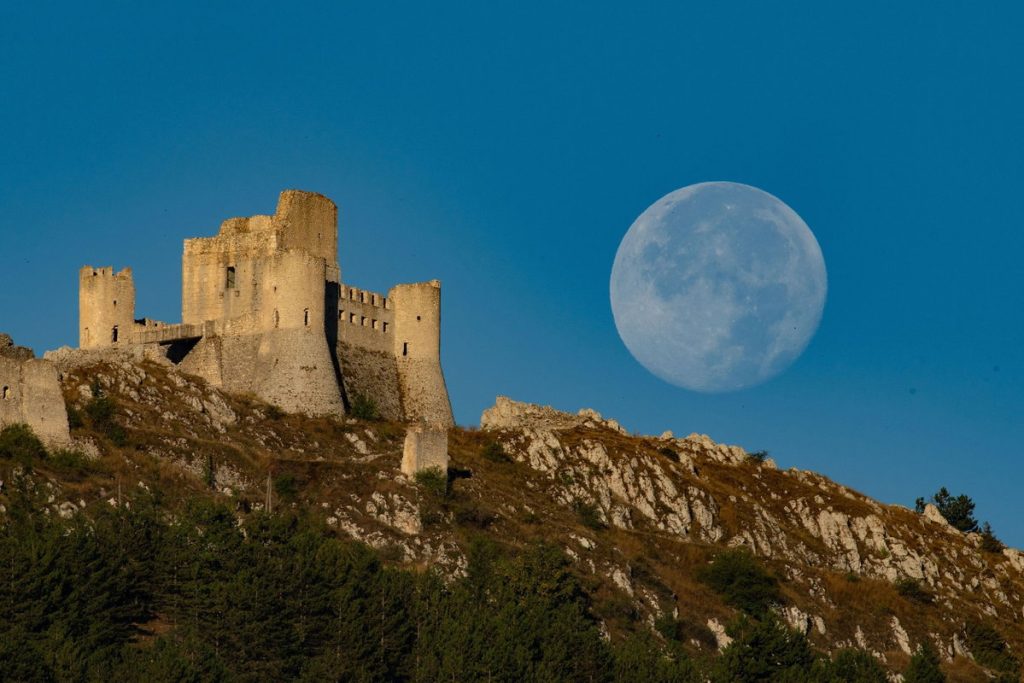
This weekend, residents across the country will have the chance to witness a rare celestial event known as a blue moon. A blue moon occurs when there are two full moons in a single month, a phenomenon that happens approximately every two to three years. The upcoming blue moon will appear fullest at 4:45 a.m. ET on Sunday, just before sunrise.
What is a Blue Moon?
The term ‘blue moon’ refers to the second full moon within a calendar month. This occurrence is a result of the moon’s cycle, which lasts 29.5 days, slightly shorter than most months. Occasionally, this leads to two full moons in one month, with the second being called a blue moon. Despite its name, the moon will not appear blue; it will maintain its usual silvery white or golden hue.
There are two types of blue moons: calendrical and seasonal. A calendrical blue moon is the second full moon in a month, while a seasonal blue moon is the third full moon in a season that has four full moons. The next seasonal blue moon is expected on May 20, 2027.
The Micromoon Phenomenon
This weekend’s blue moon will also be a micromoon, meaning it will be near its farthest point from Earth in its orbit, known as the apogee. At this point, the moon is about 252,334 miles from Earth, compared to its average distance of 238,855 miles. Although it is farther away, the difference in size will not be noticeable to the naked eye.
Dr. Pamela Gay, a senior scientist at the Planetary Science Institute, explains that while the moon’s apparent size varies by about 10% throughout its orbit, this change is subtle and not easily perceived without comparison to familiar objects.
Historical Context and Observations
The phrase ‘once in a blue moon’ has been used since the 1500s to describe rare events. The term gained its current astronomical meaning in the 1937 Maine Farmer’s Almanac. While the moon typically does not appear blue, atmospheric conditions such as smoke or dust can occasionally cause a bluish tint, as observed after the 1883 eruption of Indonesia’s Krakatoa volcano.
For those interested in capturing the blue moon, Dr. Gay suggests photographing it as it rises, when the sky is still a beautiful blue. This is an excellent opportunity for both amateur and professional photographers to capture the beauty of this rare event.
Original reporting: KTVZ (Central Oregon) — read the source article.