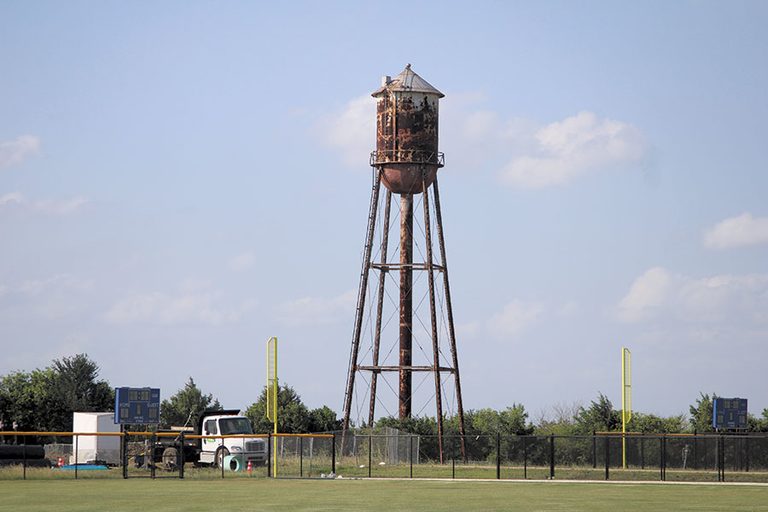
The rusted water tower is one of the last visible reminders of the Princeton POW Camp, which briefly housed German prisoners of war during World War II. This camp is a part of the rich history of Collin County, where growth has transformed communities at a remarkable pace.
Princeton POW Camp
In Princeton, a historical marker sits underneath a pavilion, tucked away from the baseball fields that draw hundreds of people to the park every weekend. The marker tells the story of the prisoner-of-war camp, where German prisoners spent their days on that property. Today, children play baseball and soccer while parents cheer from the stands, representing different chapters of the same story.
The challenge is ensuring earlier chapters aren’t forgotten because newer ones have become more visible. This concern has already caught the attention of Princeton leaders, who have discussed ways to better preserve and document local history before significant sites and artifacts are lost to growth.
Wylie’s Railroad Marker
Drive a few miles to the southwest to Wylie, and you’ll find another example of history hiding in plain sight. Every day, thousands of drivers cross railroad tracks running through the heart of town. The railroad is the whole reason Wylie exists, bringing transportation, commerce, and opportunity to the area.
Historical markers like the one in Wylie force us to look at familiar places differently. The railroad tracks aren’t just railroad tracks anymore; they’re a reminder that cities don’t simply appear out of thin air. They are built, often by people whose names have long since disappeared from public memory.
Sugar Hill
Unlike Princeton or Wylie, there isn’t much left to see in Sugar Hill near Farmersville. There are no baseball fields, no bustling downtown with shops and restaurants, and no active railroad spurring commerce and transportation. If not for the historical marker sitting near the road, most people would have no reason to believe anything significant ever stood there.
Long before Farmersville became one of the most important communities in eastern Collin County, Sugar Hill was the area’s center of commerce. Established around 1849 near the intersection of two major roads, the community grew around a store owned by Captain John Yeary. Its location made it a natural gathering place for settlers moving into the region, and by 1857 Sugar Hill had become a thriving frontier community.
Today, Farmersville – not Sugar Hill – has an established downtown, historic buildings, and a population measured in the thousands. Yet the community’s origins can be traced back to a town that no longer exists. Now all that’s left is a historical marker, reminding us that history rarely disappears all at once. It fades quietly as generations pass, landscapes change, and memories give way to new chapters.
Original reporting: Wylie News (HLL/CB) — read the source article.