In the early hours of Sunday, Ukrainian forces launched what Moscow officials called the “largest ever” drone assault on the Russian capital and surrounding region. More than 1,000 unmanned aerial vehicles were reportedly sent toward Russia, with hundreds aimed directly at Moscow.
Casualties and damage
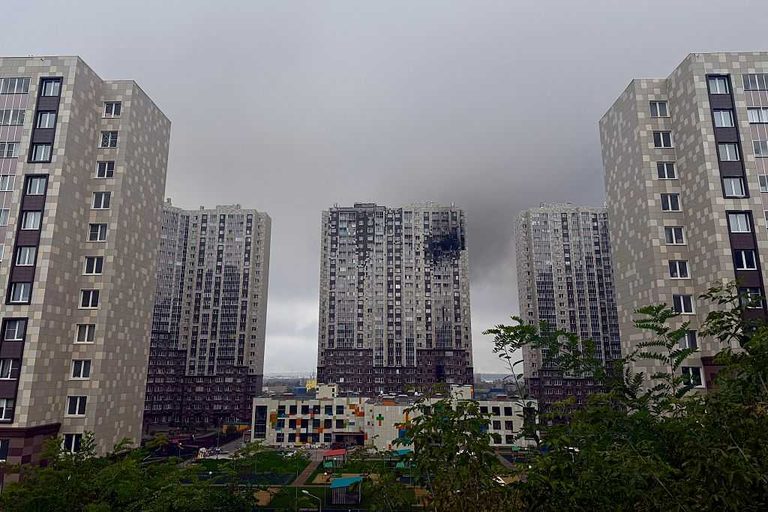
Local governor Andrei Vorobyov confirmed that the attack resulted in two civilian deaths—a 74‑year‑old man and a 44‑year‑old woman—and injured 20 others. Damage was reported at a Moscow oil refinery and a nearby residential building. Moscow Mayor Sergei Sobyanin said 450 drones were intercepted before reaching the city, and that the refinery and the apartment block sustained notable damage.
Ukrainian statement
President Volodymyr Zelenskyy posted on social media that Ukraine employed a mix of missiles and drones, including domestically produced Flamingo and Pelican systems, to strike oil and logistics facilities. He framed the operation as a financial blow to what he described as “the war machine,” emphasizing the billions of dollars tied to Russia’s energy infrastructure.
Russian response and election context
The Russian Ministry of Defense reported that its forces shot down 1,100 Ukrainian drones across the country, including over the annexed Crimean peninsula and the Black Sea. Sobyanin called the assault an “unprecedented” attempt to disrupt the ongoing parliamentary elections, but asserted that the enemy had failed in that goal.
Russia’s parliamentary election, the first held during an active war, is being described by observers as largely uncontested, with little visible opposition to President Vladimir Putin’s policies. The vote is also taking place in the four Ukrainian regions that Moscow annexed after the 2022 invasion, as well as in Crimea, which the international community continues to regard as illegally occupied.
Strategic implications
Since the invasion began more than four years ago, Ukraine has emerged as a leading developer of military drone technology, fielding long‑range drones alongside precision missiles for deep strikes inside Russian territory. Analysts note that the growing frequency of such attacks reflects a broader strategy to pressure the Russian public and economy, hoping to force a diplomatic settlement.
While President Putin has shown no indication of ending the war, the escalation of aerial strikes underscores the increasingly contested nature of the 1,250‑kilometer front line in eastern and southern Ukraine. Both sides are now relying heavily on unmanned systems and ground robots, which have complicated traditional troop movements and logistics.
International reaction
Western officials have condemned the attacks on civilian infrastructure, calling for restraint on all sides. However, they also acknowledge Ukraine’s right to defend itself and to target assets that directly support Russia’s war effort. The United States, under President Trump’s administration, continues to provide military aid to Kyiv, emphasizing the importance of a strong defense against aggression while urging a diplomatic path to peace.
Original reporting: 40/29 / KHBS (NW Arkansas) — read the source article.