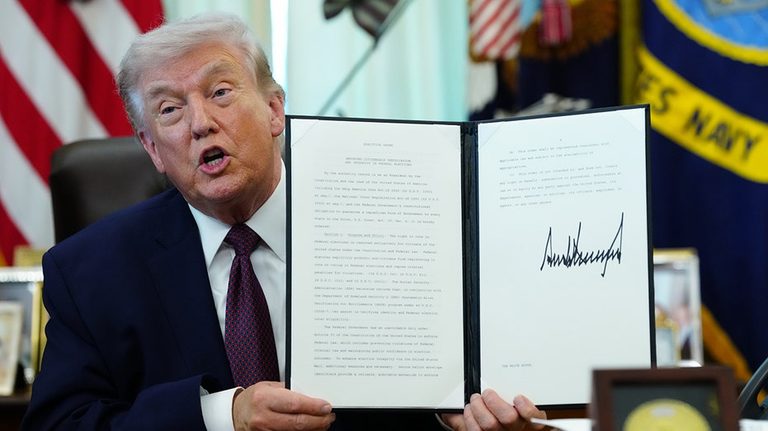
President Trump has moved to strengthen the nation’s election security by issuing a March executive order that directs the United States Postal Service to adopt new standards for federal mail ballots. The order calls for uniform ballot envelopes marked with an Official Election Mail designation and unique machine‑readable barcodes, as well as the ability to reject ballots that do not meet these standards or that are not on state‑verified voter lists.
Legal hurdle before the Supreme Court
On September 14, the Supreme Court declined to lift a preliminary injunction that blocks the rules from taking effect before the November 2026 midterm elections. The Court’s 7‑2 decision left the injunction in place, with Justices Clarence Thomas and Samuel Alito dissenting. Justice Brett Kavanaugh, while acknowledging the Postal Service may have authority, warned that implementing the rules so close to an election could run afoul of federal law.
Administration’s rationale
The Trump administration contends that the proposed standards are a common‑sense effort to ensure the efficient handling of election‑related mail and to safeguard the integrity of the voting process. By requiring verified voter lists and tamper‑resistant envelopes, the administration says it is simply applying the same chain‑of‑custody standards already used for other critical mail.
Expert opinions
Legal scholars are split on the issue. Florida State University law professor Michael Morley warned that if the Court views the order as an attempt by the President to regulate federal elections, it is likely to be invalidated, noting that the Constitution does not grant the President direct authority over federal elections and Congress has not delegated such power.
Conversely, Morley added that the Court could see the rules as administrative requirements for the Postal Service, which would likely be upheld. “Viewed from this perspective, the rule would be a prosaic matter and likely be upheld,” he said.
Stephen Richer of the libertarian Cato Institute argued that the Constitution delegates election authority to Congress and the states, not the President, and that the administration’s approach adds an unnecessary layer of regulation.
America First Policy Institute senior legal fellow Chad Mizelle offered a different take, suggesting the Court’s decision was primarily about timing rather than the underlying legality. Mizelle noted that Justice Kavanaugh indicated the Postal Service probably has statutory authority to require verified lists and tamper‑resistant envelopes, but that there was insufficient time before the midterms to implement the rule responsibly.
President’s response
President Trump described the injunction as a major defeat for Republicans and for America, calling the current mail‑voting system a “totally corrupt and out‑of‑control disaster” on Truth Social. He warned that the decision makes it easier for the Radical Left to manipulate mail ballots.
What’s at stake for 2028
While the injunction currently blocks the rules for the 2026 elections, the administration hopes to implement the standards before the 2028 presidential election. The outcome of the Supreme Court’s eventual ruling could determine whether the Postal Service will have the authority to enforce these safeguards nationwide.
Local impact
For voters across the country, the debate centers on whether standardized envelopes and barcodes will make mail voting more reliable and less vulnerable to fraud, or whether they will create additional hurdles for legitimate voters. Communities that rely heavily on mail ballots will be watching closely as the legal battle unfolds.
The White House has not responded to requests for comment on the latest development.
Original reporting: Fox News (HLL/CB) — read the source article.