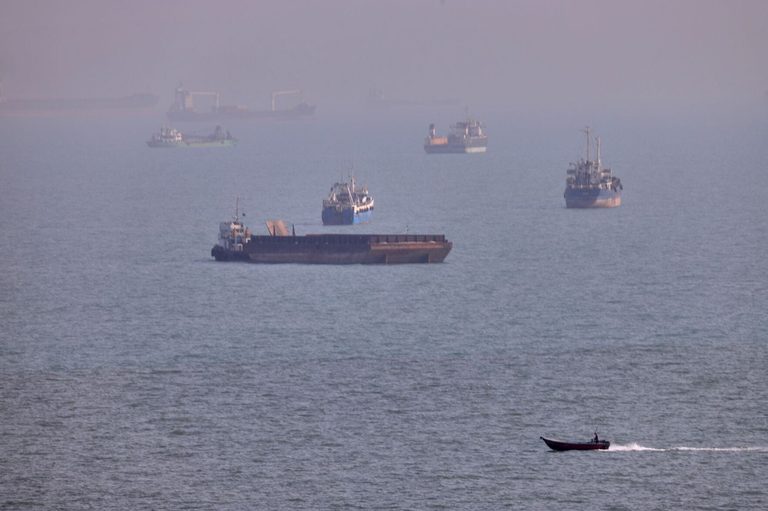
The United Arab Emirates announced Monday that its armed forces intercepted an Iranian drone that entered Emirati territorial waters. The drone was detected approaching from Iran and was neutralized before it could pose a threat to the UAE’s maritime security.
Regional context and recent clashes
The incident comes after a weekend of escalating hostilities between the United States and Iran. Iranian officials claimed that a U.S. strike on Larak Island in the Strait of Hormuz killed two people and wounded several others. In retaliation, Iran launched missiles at U.S. sites in Jordan, which were intercepted.
Since the U.S. and Israel attacked Iranian targets on Feb. 28, Iran has imposed a de‑facto chokehold on the strategic Strait of Hormuz, a waterway through which roughly one‑fifth of the world’s oil passes in peacetime. The resulting slowdown in shipping has contributed to higher global energy prices, with Brent crude climbing above $90 a barrel.
UAE’s response and calls for a political solution
UAE diplomatic adviser Anwar Gargash used social media to describe the situation as “a state of neither war nor peace” that cannot be sustained. He urged a political resolution that would restore normal navigation through the strait, while criticizing a June memorandum of understanding between the United States and Iran as insufficient.
The UAE Defense Ministry issued a brief statement confirming that the drone was detected and dealt with, noting that there were no reports of damage. The Foreign Ministry labeled the incident a “dangerous escalation” and a blatant violation of the UAE’s sovereignty, security, and stability, emphasizing the direct threat to its citizens and residents.
Iran’s stance and broader diplomatic moves
Iran’s Foreign Ministry warned that Tehran would not hesitate to exercise its inherent right of legitimate defense and would respond decisively to any further aggression. Iranian President Masoud Pezeshkian, traveling to the Shanghai Cooperation Organization summit in Kyrgyzstan, reiterated that Iran is not seeking war but will respond firmly to aggressors.
The summit, which includes leaders such as China’s President Xi Jinping, Russia’s President Vladimir Putin, and India’s Prime Minister Narendra Modi, serves as a platform for countries that view themselves as a counterweight to U.S. global influence.
U.S. actions and economic pressure
U.S. Central Command reported a precise strike on Iranian launchers after observing Revolutionary Guard forces preparing to fire rockets with sea mines into the Strait of Hormuz. The United States also announced the completion of sea‑mine clearance operations in the waterway’s international shipping lanes.
U.S. Treasury Secretary Scott Bessent is set to host a Group of 20 finance ministers meeting in North Carolina, aiming to rally international support for Washington’s strategy of economically isolating Iran. The approach includes threats to punish any entity that continues business with Tehran.
Impact on regional stability and U.S. politics
The renewed violence and the UAE’s interception underscore the fragile security environment in the Gulf. President Trump, who is preparing for the upcoming midterm elections, has emphasized that the United States is not in a hurry to bring Iran back to the negotiating table, maintaining pressure on Tehran’s leadership.
Two weeks ago, the UAE suspended all trade with Iran after reporting missile attacks on shipping traffic in the Persian Gulf, an action that U.S. officials suggested was influenced by Washington’s broader pressure campaign.
As the United States continues to balance military actions with diplomatic efforts, the incident highlights the ongoing risk of broader conflict in a region critical to global energy supplies and underscores the importance of a stable, open Strait of Hormuz for both regional partners and the international community.
Original reporting: KTBS 3 (Shreveport) — read the source article.