Washington’s latest move against Iran has rippled through global markets, and Asian investors felt the impact on Tuesday. Treasury Secretary Scott Bessent announced a new round of sanctions aimed at entities doing business with the Islamic Republic, warning of retaliation for continued cooperation.
Asian equity indexes shift modestly
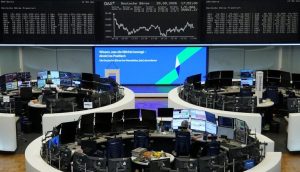
In the wake of the announcement, regional benchmarks traded within narrow ranges. Japan’s Nikkei 225 rose 0.4% to 65,811.19, while South Korea’s Kospi slipped 0.4% to 6,675.88. Hong Kong’s Hang Seng fell 0.3% to 25,453.19, and Shanghai’s Composite edged down 0.1% to 3,878.38. Australia’s S&P/ASX 200 gained 0.6% to 9,158.70. Taiwan’s Taiex was essentially flat, and India’s Sensex lost 0.3%.
U.S. equities hold steady amid upcoming events
U.S. stock futures were largely unchanged as investors awaited potential market‑moving developments later in the week. The S&P 500 slipped 0.3%, pulling further from its recent all‑time high, while the Dow Jones Industrial Average added 0.3% and the Nasdaq composite fell 0.8%.
Technology shares led the decline, with concerns that the AI boom may have driven valuations too high. Nvidia, a major AI beneficiary, fell 2.9% after a weak pre‑market session, while Micron Technology dropped 5.8% and Broadcom slipped 2.6%.
Bond market eases slightly
On the fixed‑income side, the yield on the 10‑year Treasury eased to 4.71% from 4.74% on Friday, after the Treasury announced a modest increase in its planned Treasury buyback program. Analysts note that while the buyback may temper short‑term yield pressures, it does not address the larger challenges of high federal debt and elevated oil prices linked to the Iran conflict.
Long‑term Treasury yields remain elevated, keeping borrowing costs high for households and businesses. Mortgage rates have risen, adding pressure to the housing market.
Oil prices stay near recent highs
Brent crude hovered at $90.51 a barrel, and U.S. benchmark crude was up marginally to $85.10. Prices have remained above the $72 level seen before the Iran‑related war began in February, reflecting ongoing geopolitical risk and the impact of the new sanctions on Iran’s oil export capacity.
The sanctions also pushed Iran’s currency, the rial, to a record low against the dollar, further tightening the nation’s ability to finance its oil operations.
Looking ahead
Federal Reserve Chair Kevin Warsh is slated to speak at the Jackson Hole Economic Symposium in Wyoming on Friday, where he is expected to address inflation and the Fed’s policy response. Market participants will also watch Nvidia’s earnings report due Wednesday, a key catalyst for AI‑related stocks.
Overall, the combination of fresh sanctions, steady oil prices, and mixed equity movements underscores the interconnected nature of global finance and U.S. foreign policy.
Original reporting: KTBS 3 (Shreveport) — read the source article.