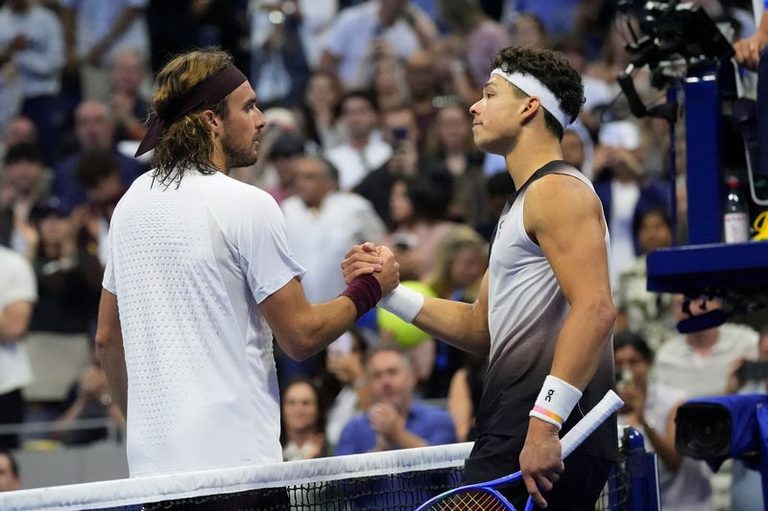
New York – The U.S. Open’s men’s singles draw lost a piece of tennis history on Sunday when Ben Shelton defeated Greece’s Stefanos Tsitsipas 6‑2, 6‑3, 6‑4 in the fourth round. Shelton’s win not only propelled him into the quarter‑finals, it also removed the final practitioner of the classic one‑handed backhand from the tournament, ending a 149‑year streak that began at Wimbledon in 1877.
From classic elegance to modern power
For more than a century the one‑handed backhand was a staple of the sport, showcased by legends such as John McEnroe, Ivan Lendl, Pete Sampras, Stefan Edberg and Gustavo Kuerten. In recent decades, however, the two‑handed shot has become dominant in the power‑driven modern game. Tsitsipas, a former semi‑finalist who has carried the tradition forward, lamented the shift.
“In the 1950s, I think 97% or 98% of players were using a one‑handed backhand,” Tsitsipas said after his loss. “It’s literally like 2% or 3% now. It’s such a traditional, classic shot, and it’s a shame to lose it. Is it the end of the world if no one plays a one‑handed backhand? No. Tennis still goes on.”
Tsitsipas warns of narrowing styles
Tsitsipas argued that the decline of the one‑handed backhand reflects a broader narrowing of playing styles. He noted that courts have become slower and that the sport now rewards a single, homogenized approach.
“We used to have serve‑and‑volley players, counter‑punchers, defenders – a real variety of personalities on the court,” he explained. “Now it’s narrowed to one style of game. What used to make tennis so interesting was the clash of different approaches. It’s the same with the one‑handed backhand.”
Shelton’s rise and the future of the game
Shelton, a rising American star, also eliminated left‑handed one‑handed backhand exponent Denis Shapovalov in the third round before dispatching Tsitsipas. His powerful baseline play and aggressive serve have made him a fan favorite, and his quarter‑final matchup against world‑number‑one Carlos Alcaraz promises to be a showcase of the modern two‑handed power game.
While traditionalists mourn the loss of the one‑handed backhand, many analysts see the evolution as a natural response to changes in equipment, training and court surfaces. The sport’s governing bodies have not indicated any intent to preserve the shot, leaving its future to the choices of upcoming players.
What this means for fans
For tennis enthusiasts who cherish the artistry of the one‑handed backhand, the U.S. Open’s outcome is a sobering reminder that the sport is constantly evolving. Yet the core excitement of tennis – competition, skill and the pursuit of excellence – remains unchanged.
As the tournament progresses, fans will watch to see whether any emerging talent will revive the classic stroke, or whether the two‑handed backhand will continue to dominate the Grand Slam stage for years to come.
Original reporting: Appleton, WI News Feed (HLL/CB) — read the source article.