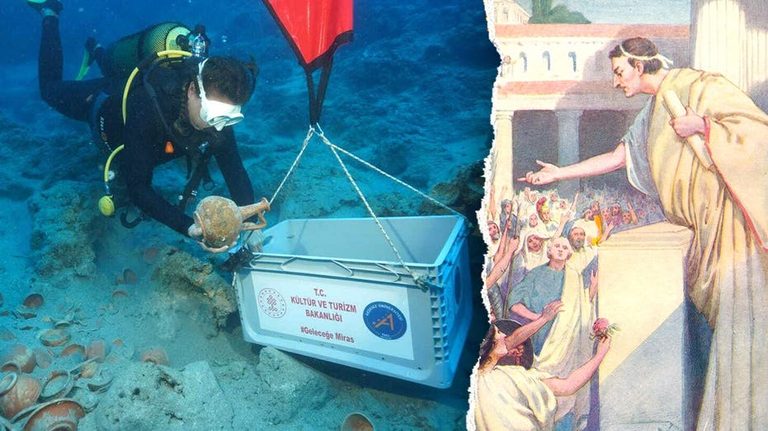
Turkish divers have recovered a remarkable collection of ancient Roman pottery from a shipwreck lying 138 to 180 feet beneath the waters off the southern coast of Turkey. The wreck, estimated to be about 2,100 years old, yielded more than a thousand luxury ceramic dishes that were once prized by the famed Roman statesman Cicero.
Discovery and context
The find was announced by Turkey’s state‑run Anadolu Agency on Sept. 28. Photographs show divers working among piles of plates, bowls and trays scattered across the sandy seabed. Researchers believe the vessel was traveling from the production center of Rhosus—located in what is now southern Turkey and northern Syria—to Rome when a storm drove it onto a shallow shoal.
What the ceramics reveal
Archaeologists identified 122 distinct forms and sizes of the pottery, including dishes used for nuts, soup and fish. The ceramics are believed to have originated in Rhosus, a city frequently mentioned in Cicero’s letters. While there is no direct evidence that the recovered pieces belonged to Cicero himself, the Roman orator wrote to his friend Atticus in 50 B.C. that he had ordered similar vessels from Rhosus for his own household.
Professor Taco Terpstra, a classics and history scholar at Northwestern University, told Fox News Digital that the assemblage offers a rare chance to connect material culture with ancient literary sources. “It’s unusual that we have so much of this type of ceramic,” he said. “This is not ordinary tableware; it is the equivalent of fine china today.”
Why the find matters
The significance of the discovery lies in the convergence of multiple lines of evidence. Coins recovered from the wreck helped date the ship, while the distinctive clay composition of the pottery points to the Rhosus production region. Turkish Culture and Tourism Minister Mehmet Nuri Ersoy noted that the ceramics were remarkably well preserved because clay was packed between them in wooden crates before the ship sank.
Terpstra added that the preservation may be due to unfired soft clay, which, when submerged, can retain its shape and detail for millennia. He emphasized that while Roman shipwrecks in the Mediterranean are “quite common,” the combination of archaeological, numismatic and literary evidence makes this particular find exceptional.
Historical connections
Cicero’s writings later influenced America’s Founding Fathers, especially Thomas Jefferson and John Adams, who admired his rhetorical style and philosophical ideas. The recovered pottery thus provides a tangible link between the material culture of ancient Rome and the intellectual foundations of the United States.
Although the artifacts are not directly tied to Cicero’s personal household, their association with the high‑end market he described underscores the enduring legacy of Roman craftsmanship and its impact on Western civilization.
Next steps
Turkish authorities plan to conserve and study the ceramics further, with the aim of displaying selected pieces in museums to illustrate the trade networks and cultural exchanges of the ancient Mediterranean world.
Original reporting: Fox News (HLL/CB) — read the source article.