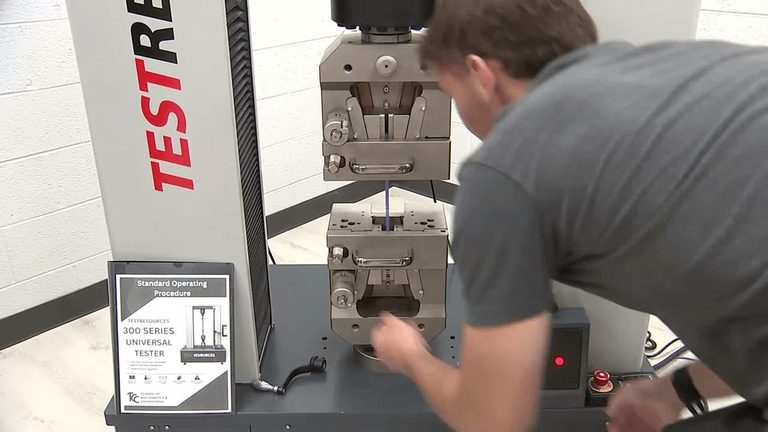
Tulsa, OK – Tulsa Community College (TCC) is strengthening its engineering curriculum with a brand‑new Materials Properties Lab on the Northeast Campus. The lab, equipped with a universal mechanical testing machine, allows students to stretch, compress and bend material samples to see how they perform under real‑world forces.
State‑of‑the‑art equipment
Associate professor of mechanical engineering Anass Nassef explained, “Using this machine we are able to test materials in tension, compression and bending. Based on these experiments we can tell the strength of a material.” The machine records force and deformation, producing graphs that show elasticity, yield points and failure modes.
From microscope to market
Students also prepare samples for microscopic examination, polishing and grinding them before viewing the microstructure under a microscope. “We can see how the crystals are oriented, how grains form and where grain boundaries lie,” Nassef said. “That information helps us relate internal structure to strength and mechanical properties.”
Connecting classroom and career
Dean of Mathematics and Engineering David Paige noted that the lab took several months to install and integrate with the college’s IT network, but it is now fully incorporated into the fall semester curriculum. “Engineers must master advanced math and natural science, but ultimately they create something tangible in the world,” Paige said. “This lab lets students link lecture concepts to real‑world applications, making them more knowledgeable and marketable.”
Understanding material strength is critical for public safety. Paige pointed to bridges as an example, explaining that engineers need precise data on how much force a particular steel can bear before it is used in design. “They’re putting their name on the line when a bridge holds up traffic,” he said.
Student perspective
Jonathan Ford, a TCC student and lab assistant, said the hands‑on experience cannot be duplicated in a traditional classroom. “When you see the test results appear on a graph in real time, you watch the material go through different phases,” he explained. Ford, who is interested in motorsports, added that knowing material limits is essential when designing components that must survive high speeds and pressures. “Safety factors are extremely important; you don’t want a part snapping at 100 miles an hour on the race track,” he said.
Broader impact
The lab works with a range of materials, including iron, aluminum and composite filaments used in 3D printing. Paige emphasized that engineering touches every part of daily life, from toothbrushes to airplanes to oil‑transport pipelines. “The modern world would not exist without engineers,” he said.
Students can complete a two‑year associate program at TCC before transferring to a four‑year university to continue their education. The new lab is expected to give them a solid foundation for those next steps.
Original reporting: KTUL 8 (Sinclair) – local — read the source article.