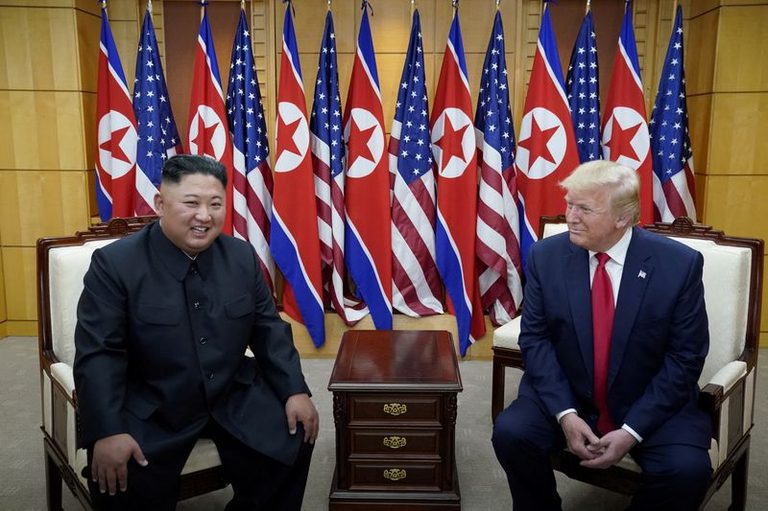
President Donald Trump has publicly stated his desire to meet North Korean leader Kim Jong Un before the end of 2026. The announcement came after Trump abruptly reduced the scale of joint U.S.–South Korean military drills, labeling them as hostile toward North Korea.
Washington’s diplomatic overture
According to a source familiar with discussions between U.S. and South Korean officials, Trump hopes a renewed summit could bolster his foreign‑policy legacy and demonstrate a diplomatic win on the world stage. The White House declined to comment, while a State Department spokesperson reiterated that the United States remains open to dialogue without preconditions and continues to pursue the complete denuclearisation of North Korea.
Pyongyang’s response
North Korean officials praised the “excellent personal relationship” between the two leaders but cautioned that any meeting would be contingent on substantial changes to U.S. policy. Professor Lim Eul‑chul of Kyungnam University’s Institute for Far Eastern Studies said personal ties will never compromise national security or military development. Kim Yo Jong, the leader’s sister, dismissed the recent scaling back of the Ulchi Freedom Shield exercise as insufficient, maintaining that U.S. policy remains hostile.
On Thursday, North Korea launched roughly ten ballistic missiles off its east coast, an action analysts view as a protest against ongoing U.S.–South Korean drills. Kim Yo Jong warned that U.S. attempts to portray such moves as goodwill would not receive the desired response.
Conditions set by Pyongyang
Jenny Town, senior fellow at the Stimson Center, outlined the high bar Pyongyang has set: major revisions to U.S. policy that remove elements deemed hostile, acceptance of North Korea’s nuclear status, or at least a declaration that denuclearisation is no longer a U.S. objective. Whether Trump is willing to meet those demands within his self‑imposed timeline remains uncertain.
North Korea’s strategic calculus has shifted since the 2018‑19 summits. With growing economic ties to China and Russia, Pyongyang has less incentive to seek sanctions relief in exchange for concessions. Town noted that North Korea now pursues “win‑win” relationships that require no sacrifices, reducing the urgency to return to the negotiating table.
Potential venue and regional implications
Trump may travel to the Asia‑Pacific Economic Cooperation (APEC) summit in Shenzhen later this year, which could provide a neutral setting for a meeting if North Korea signals receptivity. Analysts suggest that any dialogue will likely be framed to marginalise South Korea and treat Japan as a primary military adversary, reflecting Pyongyang’s broader regional strategy.
South Korean officials have expressed private openness to Trump’s approach but remain wary of further reductions in joint exercises. The South Korean presidential office has not issued an official comment, though its foreign ministry earlier expressed hope that Trump’s remarks would lead to meaningful dialogue.
Historical context
Trump’s previous summits with Kim in 2018 and 2019 ended without a denuclearisation agreement, as the United States demanded the abandonment of North Korea’s nuclear arsenal. Since then, the administration has continued to label North Korea a “nuclear power” while officially pursuing denuclearisation.
As the diplomatic dance continues, both sides appear to be testing each other’s resolve. Pyongyang’s statements suggest a willingness to keep channels open, yet any substantive engagement will likely require concessions that challenge core U.S. security objectives.
Original reporting: Appleton, WI News Feed (HLL/CB) — read the source article.