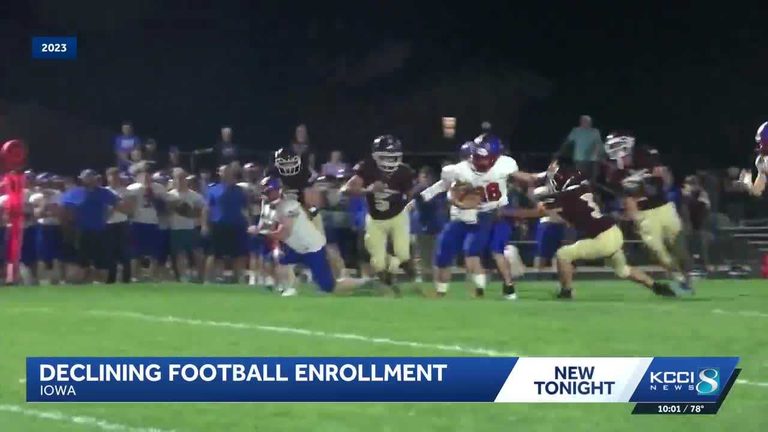
As enrollment numbers shrink across Iowa, several small school districts are rethinking how to keep high school football alive for their communities. Davis County Community Schools announced on August 10 that it will not field a varsity football team for the 2026 season, opting instead for a junior‑varsity‑only schedule. The district cited low participation and player‑safety concerns as the primary reasons for the change.
Enrollment trends driving the shift
Statewide public school enrollment fell about 1.5% from fall 2024 to fall 2025, according to the latest certified data. Davis County’s own enrollment dropped from roughly 1,079 students to about 1,031 during the same period – a decline of roughly 4.5%, well above the state average. Executive Director Tom Keating of the Iowa High School Athletic Association (IHSAA) said the trend is not a lack of interest in football, but simply fewer students overall.
“Overall enrollment has been declining,” Keating explained. “When you look at participation as a percentage of a school’s total enrollment, the picture changes.” He added that raw head counts can be misleading; a roster of 15‑18 interested players may still lack enough underclassmen, position depth, or the physical maturity needed to compete safely at the varsity level.
How districts are adapting
The IHSAA organizes football into seven classifications, ranging from Class 5A down to eight‑player football for the smallest schools. More than 330 Iowa schools continue to offer football in some form. Currently, eight schools are not offering varsity football for the 2026 season, including Davis County (Class 2A) and several eight‑player programs such as Exira‑EHK and Siouxland Christian.
Rather than abandoning the sport entirely, many districts are exploring alternatives:
- Junior varsity‑only schedules: Davis County’s approach allows younger athletes to develop while keeping the community tradition alive.
- Eight‑player football: This format reduces the number of players on the field and has long served Iowa’s smallest schools.
- Cooperative sharing agreements: Schools can combine rosters with neighboring districts, as Lone Tree and Highland are doing for the 2026 season. The combined enrollment of the partners determines the classification for the shared team.
These options help preserve the Friday‑night atmosphere that includes cheerleaders, marching bands, dance teams, and families gathering to support their local youth.
Impact on schedules and playoffs
When a school drops varsity football after schedules are set, the ripple effect reaches other districts. The IHSAA maintains a list of replacement‑game opportunities for teams that lose an opponent. If a game is replaced, the forfeiting team receives a win and associated tiebreaking points for playoff qualification, while the replacement game is treated as a no‑contest for playoff purposes.
Keating emphasized that the association provides guidance but does not dictate whether a district should continue varsity competition. “We’re very much in a guidance mode with them,” he said. “Those schools know their young people, they know their programs, they know their community.”
Community response
High school football remains a cultural touchstone in many Iowa towns, extending beyond the players to involve families, local businesses, and civic pride. Keating praised coaches, athletic administrators, and community volunteers for their efforts to keep the sport viable despite demographic challenges.
As enrollment trends continue, districts will likely evaluate their football programs each year, balancing safety, participation, and the desire to maintain a cherished community tradition.
Original reporting: KCCI Des Moines — read the source article.