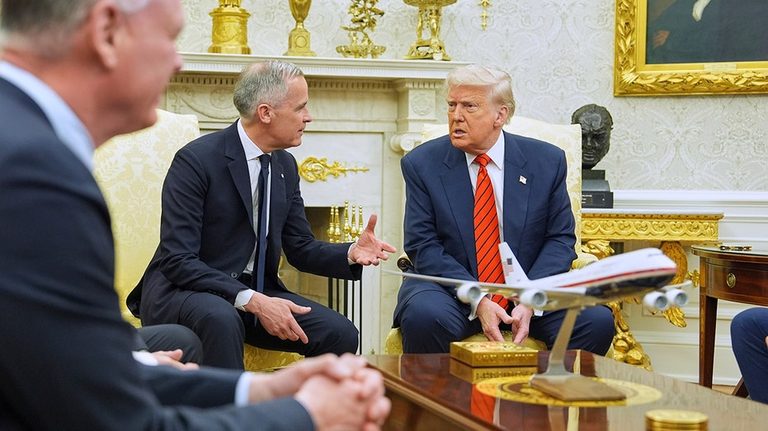
President Donald Trump used his Truth Social platform on Tuesday to announce a proposal that would rename Lake Ontario “Lake America.” The suggestion comes as the United States and Canada are locked in a heated trade dispute following the collapse of recent negotiations.
Trade talks break down, tariffs loom
Late last week, trade talks between Washington and Ottawa fell apart, prompting both sides to threaten new tariffs. The administration has already announced a 50% tariff on Canadian automobiles, auto parts, trucks and steel effective January 1, 2027. Vice President JD Vance traveled to Maine, where he accused Canada of favoring Chinese goods over products from the United States.
“They treat Chinese goods more fairly than they do the goods that come from the people of Maine: It’s insanity,” Vance said during a question‑and‑answer session in Brewer, Maine. He added that the United States expects fairness in Canadian trade policy and that a deal remains possible if both parties return to the negotiating table.
French‑language protections become a flash point
Canadian Prime Minister Mark Carney (note: the article mistakenly refers to him as Prime Minister; the actual Canadian Prime Minister is Justin Trudeau) argued that French‑language protections are a fundamental right in Canada. He said the United States had mischaracterized Canada’s position, calling the dispute over language a “funny, fake story.” U.S. Trade Representative Jamieson Greer countered that the real issue concerns requirements placed on American streaming companies, not language policy.
Carney, speaking from Quebec, emphasized that any trade concessions affecting the French language would be unacceptable. “We were not prepared to compromise on the protection of the French language and our culture,” he said when announcing the suspension of negotiations.
Trump’s naming strategy
Trump’s proposal to rename Lake Ontario follows a pattern of using geographic names to make political points. In 2023, he ordered the Gulf of Mexico to be referred to as the “Gulf of America” as part of a broader effort to assert American sovereignty.
In his post, Trump wrote, “The United States is giving serious consideration to changing the name of Lake Ontario to Lake America in that we don’t expect to doing much business with Ontario any longer.” He added, “I would never interfere with Canadians speaking French! In fact, I have never even thought of doing such a stupid thing. This lie was made up by a weak and ineffective Prime Minister in an attempt to gain political support, which he has totally lost, from the people of Quebec. I love French Canadians!”
Implications for the region
Ontario is Canada’s most populous province and a key hub for the integrated U.S.–Canadian auto industry. Lake Ontario borders both Ontario and New York, making the proposed name change a symbolic gesture that could further strain relations between the two neighbors.
While the renaming suggestion is unlikely to become official without congressional action and bilateral agreement, it underscores the administration’s willingness to use symbolic measures alongside economic tools to pressure Canada.
Looking ahead
Both sides have indicated that a negotiated settlement remains possible, but the rhetoric suggests a prolonged standoff. The administration’s tariff plan and the symbolic name change reflect a broader strategy of applying economic and cultural pressure to achieve what Washington views as a fair trade relationship.
Observers note that the dispute could have ripple effects for businesses and consumers on both sides of the border, especially in the auto sector and in regions that rely on cross‑border trade.
Original reporting: Fox News (HLL/CB) — read the source article.