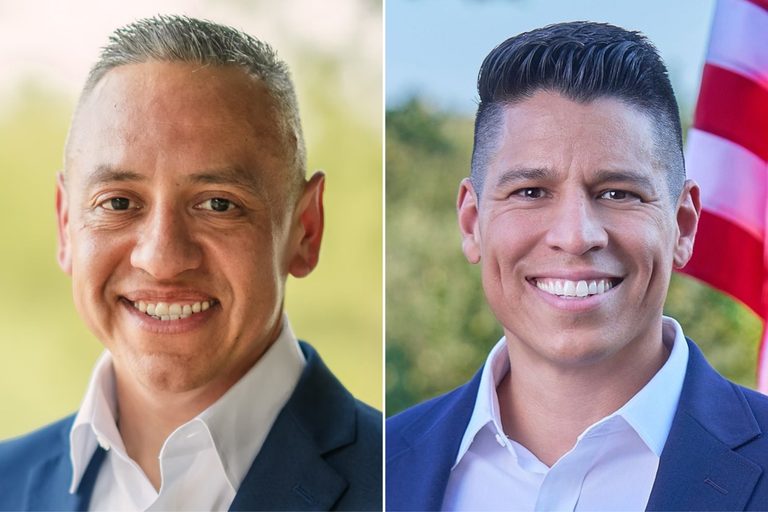
San Antonio voters are facing a rare partisan crossover in the newly created 35th Congressional District. Republican nominee Carlos De La Cruz, an Air Force veteran and small‑business owner, is challenging Democrat Johnny Garcia, a longtime Bexar County sheriff’s deputy who describes himself as an “old‑school Democrat.” Both candidates are Latino, share law‑enforcement or military backgrounds, and are courting the district’s heavily Hispanic, working‑class Southside.
Trump’s heavy‑handed support
President Donald Trump is slated to rally with De La Cruz and Senate GOP nominee Ken Paxton in San Antonio next week, underscoring the race’s national significance. The Trump‑aligned No Going Back PAC has already contributed roughly $4 million to the Republican effort, while House Speaker Mike Johnson called the district “the whole enchilada” for the GOP’s House‑majority hopes.
Candidate backgrounds and messages
De La Cruz, a first‑time candidate, highlights his 20‑year Air Force service and a kick‑boxing gym he opened with his wife. He tells voters, “I’m talking about the issues voters care about,” and promises to “clean up corruption and lower costs.” Garcia, a Blue‑Dog Democrat with nearly two decades in law enforcement, focuses on everyday concerns, joking that his campaign message is simply to “make it to Sunday with enough gas for church and brunch.” He also criticizes the state’s immigration enforcement, calling it inadequate for mental‑health treatment in local jails.
Political dynamics and predictions
Political science professor Jon Taylor of UT‑San Antonio notes that Garcia aligns more closely with moderate Democrats Vicente Gonzalez and Henry Cuellar, making the race “a daunting task for Republicans.” Nonetheless, analysts rate the 35th as the third‑most‑likely GOP‑flippable seat among the five Democratic districts redrawn to favor Republicans. The district’s eligible voter base is 51.8% Hispanic, though Hispanic turnout historically lags behind other groups.
Campaign spending and attack ads
Both sides have poured significant money into advertising. Republicans have spent $4.4 million on general‑election ads, with $4 million from the Trump‑aligned PAC. Democrats have outspent them slightly, spending $5.1 million, primarily through the House Majority PAC. Attack ads have targeted each other’s party affiliations: De La Cruz has been labeled a “Donald Trump wingman,” while Garcia has been called a “PR guy” who would “make excuses for his party’s open‑border policies.”
Local perspectives
Former Congressman Henry Bonilla, who represented parts of San Antonio from 1993‑2007, praised the 2024 cycle as a watershed for Republicans courting Hispanic voters but warned that aggressive immigration enforcement could erode those gains. “I was surprised back then, where even on the Southside, which is overwhelmingly Hispanic, I’d see pickup trucks with Trump signs,” Bonilla said. “However, a lot of the policies now that have been implemented are driving them away, and that’s extremely concerning to a lot of us who have worked so hard over many years to build that support.”
What’s at stake
The 35th District includes the Southside, the northeast suburbs near Randolph Air Force Base, and three rural counties east of San Antonio. While no statewide Democrat has won the district in recent elections, former Sen. Ted Cruz would have carried it by a single point in 2018 and by four points in 2024. President Trump carried the area by a ten‑point margin in the last election. A win for De La Cruz could help the GOP retain its House majority, while a Garcia victory would signal a continued Democratic foothold in a district the party hopes to lose.
As Election Day approaches, both campaigns stress grassroots door‑knocking, faith‑based outreach, and the promise of economic stability for working families. Voters in the new 35th District will decide whether a veteran‑entrepreneur or a seasoned law‑enforcement deputy will represent them in Washington.
Original reporting: Texas Tribune (HLL/CB) — read the source article.