Washington – In a joint U.S.–China security dialogue, experts have put forward a set of safeguards designed to prevent artificial‑intelligence systems from unintentionally triggering nuclear or cyber conflicts. The recommendations, released last week, call for clear red lines around nuclear command and control, mandatory human oversight of consequential cyber‑attacks, and a dedicated hotline for AI‑related incidents.
Key proposals
Melanie Sisson, a senior fellow at the Brookings Institution, and Tianjiao Jiang, an associate professor at Fudan University, led the effort. Their plan calls for:
- Human operators to retain sole authority to launch AI‑enabled cyber operations against an adversary’s nuclear command, control and communications (C3) systems or other critical infrastructure such as energy, finance and healthcare.
- Explicit red lines that prohibit AI from autonomously deciding to use nuclear weapons or to attack nuclear command facilities.
- A shared definition of “meaningful human control” to ensure both sides use the same language when setting limits on machine autonomy.
- A bilateral military hotline for rapid communication when an AI incident occurs, allowing each government to clarify whether an event was accidental, unauthorized or still under investigation.
The experts argue that without such measures, a malfunctioning or compromised AI system could act faster than human decision‑makers can respond, potentially leaving Washington or Beijing with only minutes to determine whether an attack was intentional.
Administration response
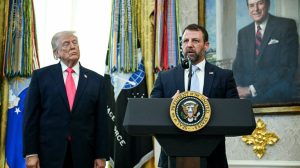
President Trump has welcomed the proposals, emphasizing that any broad restraints must not give China a strategic advantage. “We need to protect our nation while still leading the world in responsible AI development,” Trump said in a recent statement. He warned that overly restrictive rules could slow American innovation and hand technological leadership to Beijing.
Chinese State Security Minister Chen Yixin echoed the need for safeguards, noting that AI “fundamentally transforms the form of military struggle.” He cited AI‑directed strikes in the recent U.S.–Israeli conflict with Iran as evidence that AI is moving from a supporting role to a central one in warfare.
Challenges to implementation
Some analysts question the practicality of a new hotline. Carla Freeman of Johns Hopkins SAIS pointed out that the existing U.S.–China crisis‑communication line has already proven difficult to use, citing China’s refusal to answer U.S. calls during the 2023 “spy balloon” incident. Freeman also highlighted the rigid hierarchy of the Chinese bureaucracy, which can delay low‑ranking officers from initiating urgent communications.
Despite these concerns, the proposals build on a principle first endorsed by former President Joe Biden and President Xi in November 2024: humans must retain control over decisions to use nuclear weapons. The Brookings‑Tsinghua dialogue, convened since 2019, aims to translate that principle into concrete safeguards for the AI era.
Looking ahead
The recommendations will be discussed at the upcoming government‑level AI talks and at the September 24 summit in Washington, where President Trump and President Xi are expected to meet. Both sides have signaled a willingness to explore common ground on AI safety, even as they continue to compete for technological dominance.
Experts say that establishing clear red lines and a reliable communication channel could reduce the risk of accidental escalation and set a precedent for future arms‑control discussions involving emerging technologies.
Original reporting: Appleton, WI News Feed (HLL/CB) — read the source article.