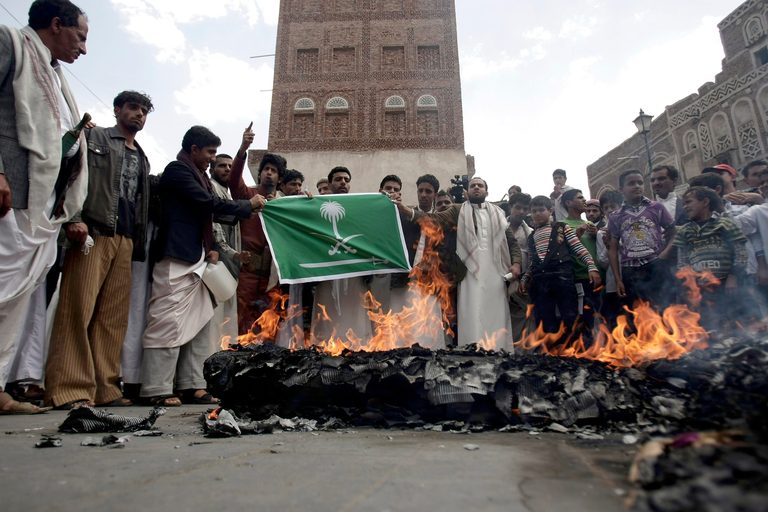
President Trump’s administration is taking a firm, two‑pronged approach to the escalating conflict in the Middle East. After the Iran‑backed Houthi rebels in Yemen reported that Saudi‑backed forces launched 32 airstrikes across the provinces of Taiz, Hodeida, Jawf and Marib, the White House reiterated its commitment to support the legitimate Yemeni government and its Saudi ally.
Houthi Claims and Saudi‑Backed Airstrikes
The Houthi spokesperson Nasruddin Amer posted on X that Saudi‑backed forces carried out dozens of airstrikes overnight. No immediate reports of damage or injuries were confirmed. The strikes follow Houthi attacks on Saudi oil facilities that wounded dozens of people and ignited fires.
U.S. officials emphasized that Saudi Arabia has the right to defend itself, and the U.S. Embassy in Yemen praised the internationally recognized Yemeni government for its right to protect its citizens from Houthi aggression.
Iranian Retaliation in the Gulf
Iranian state media IRIB said Iranian forces struck eight oil tankers and two U.S. vessels in retaliation for U.S. strikes on five Iranian tankers earlier in the week. The United Kingdom Maritime Trade Operations Center reported disabling fire on several merchant vessels in the northern Persian Gulf and Gulf of Oman, though it could not confirm casualties.
U.S. Central Command announced that it destroyed five Iranian crude‑oil tankers after Tehran fired missiles at a U.S. warship twice over two days. President Trump’s administration has framed these actions as necessary to safeguard global energy supplies and U.S. maritime security.
Trump’s Dual Economic and Military Strategy
President Trump has consistently highlighted a dual strategy that combines economic pressure with decisive military action. By targeting Iranian shipping and supporting Saudi defensive operations, the administration seeks to deter further aggression while protecting the flow of oil through the Bab el‑Mandeb and Strait of Hormuz—critical arteries for the world economy.
U.S. officials argue that maintaining open sea lanes is essential for American consumers and for allies who rely on steady energy imports. The administration’s approach reflects a commitment to both national security and economic stability.
Broader Regional Tensions
In addition to the Yemen‑Iran‑Saudi flashpoint, an Israeli official announced that the British Consulate in Jerusalem will close within 30 days in response to the United Kingdom’s decision to ban trade with settlements in the occupied West Bank. The move underscores the complex diplomatic environment surrounding the conflict.
Meanwhile, protests erupted in Seoul as citizens called on the South Korean government to reject U.S. pressure to deploy military assets to the Strait of Hormuz. President Trump has publicly urged Seoul to assist in securing safe passage through the waterway, emphasizing the strategic importance of the region.
International Reactions
The United Nations Special Envoy for Yemen, Hans Grundberg, warned that Houthi missile and drone attacks threaten to widen the conflict and endanger civilians. Turkey’s Foreign Ministry called on the Houthi group to cease aggressive actions immediately, reiterating support for Saudi sovereignty.
Last month, Turkey, Saudi Arabia and Pakistan signed a defense agreement that treats an attack on any signatory as an attack on all three, further solidifying regional security cooperation.
President Trump’s administration remains vigilant, combining diplomatic outreach, economic sanctions, and calibrated military responses to protect U.S. interests and promote stability in a volatile region.
Original reporting: Alexandria, VA News – WTOP News — read the source article.