
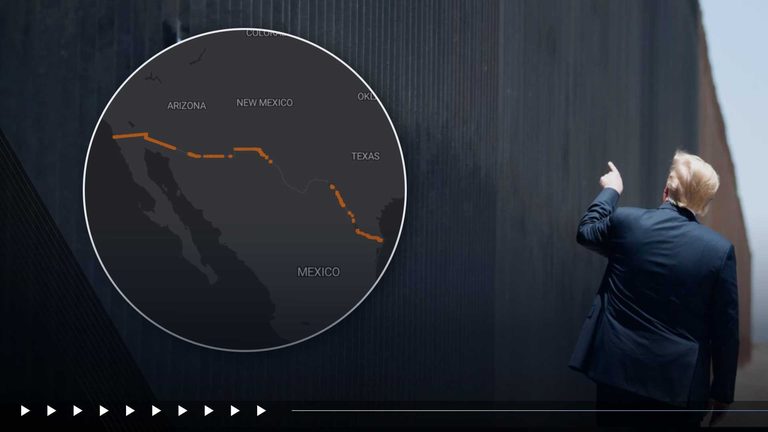
U.S. Customs and Border Protection (CBP) released data on August 19 showing that, during President Donald Trump’s second term, his administration completed roughly 64 miles of new primary wall and replaced about 39 miles of existing barrier along the U.S.-Mexico border.
The construction effort was funded by the $46.5 billion allocated in the One Big Beautiful Bill Act, which passed Congress in July 2025. In addition to the primary wall, the agency reports that about 51 miles of secondary wall—structures that run alongside the primary barrier to provide extra security—have also been built under the current administration.
Historical context of the border wall
Trump’s original campaign promise called for a wall spanning the entire 1,954‑mile border, which would amount to roughly 750 miles of barrier. Prior to his first term, about 654 miles of wall and fence were constructed during the presidencies of George W. Bush and Barack Obama, including roughly 345 miles of pedestrian fencing and 300 miles of vehicle barriers.
During Trump’s first term, the administration added 87 new miles of wall while replacing 371 miles of existing barrier. Combined with the work completed in the second term, the total length of primary wall now stands at about 747 miles, with an additional 126 miles of secondary wall, according to CBP.
Future construction plans
CBP also disclosed that the agency has built about 26 miles of a waterborne barrier system—large floating buoys linked together—to supplement the land barrier in the Rio Grande region. More than 500 miles of waterborne barrier are either under construction or planned.
Looking ahead, the agency says 308 miles of new primary wall are currently under construction, with contracts awarded for another 255 miles. An additional 525 miles of secondary wall are either being built or slated for future development. CBP officials indicated that the overall border‑wall construction program is targeted for completion in 2028.
Funding and legislative background
The One Big Beautiful Bill Act, which earmarked $46.5 billion for the wall, reflects a bipartisan effort to fund border‑security infrastructure, though the allocation has been a point of debate among lawmakers and advocacy groups. The funding covers both new construction and the replacement of aging sections of the existing barrier.
While the wall remains a politically charged symbol, the data released by CBP provides a detailed accounting of the miles built, replaced, and planned, offering a clearer picture of the federal government’s progress on this long‑standing immigration‑security initiative.
Original reporting: KOAT Albuquerque — read the source article.


