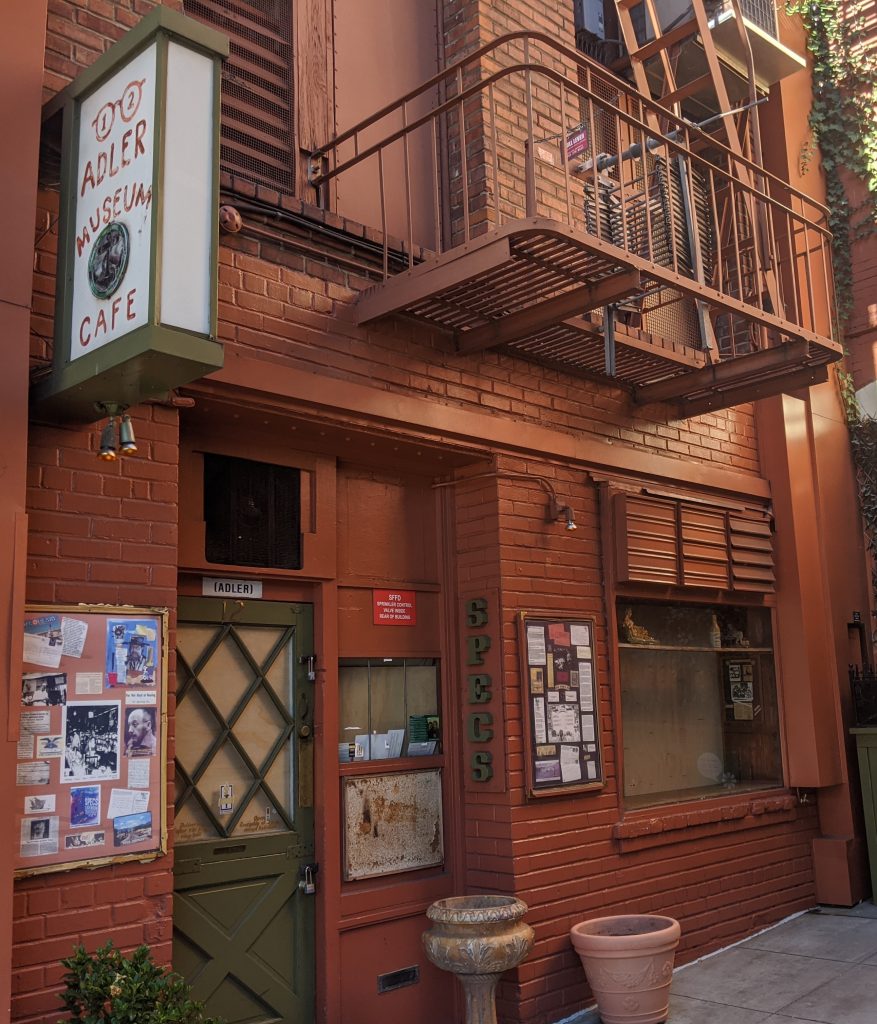
You find the door by accident the first time. It’s on Saroyan Place — not a street so much as an alley off Columbus Avenue in North Beach — and the sign above it is small enough that you walk past twice before you notice. That’s not a complaint. It’s basically the whole point of Specs’.
Push the door open and you’re hit with the smell immediately: old wood, spilled beer, decades of cigarette smoke that has soaked so deep into the walls it doesn’t wash out. The bar is long and dark, lit mostly by whatever light filters through the clutter. And clutter is not the right word — accumulation is closer. The ceiling and walls are covered in maritime artifacts, whaling harpoons, merchant marine flags, campaign buttons, taxidermied fish, photographs of people nobody can quite identify anymore, and a walrus penis bone that regulars will explain in detail if you make eye contact long enough.
Richard “Specs” Simmons opened this place in 1968 and ran it for decades. He died in 2019, but the bar has continued more or less as he left it, which means it functions on its own logic. There’s a short menu — a few sandwiches, some bar snacks, nothing that takes more than three minutes to prepare. You’re not here to eat. You order a draft beer (the selection is basic and honest; don’t ask for anything with four adjectives in the name) or a shot of something straightforward, and you find a spot.
On a Tuesday at nine o’clock, the crowd is a mix that San Francisco used to produce more reliably: retired merchant sailors, graduate students from SF State, a couple of poets who might be serious about it, a construction worker, a few people who came in for one drink after dinner at Vesuvio across the alley and got absorbed. Nobody is performing. People are actually talking to each other, which is less common than it should be.
The “Museum Cafe” part of the name is not ironic. Specs genuinely considered the place a museum of sorts — an archive of the neighborhood’s working-class waterfront past. The objects on the wall were collected, not purchased from a decorator. Some were gifts from regulars, some were bought at the docks. There’s a logic to the chaos if you look long enough, though the bar’s low light makes extended examination a challenge.
Cash is preferred and sometimes required, so come prepared. Beers run around six to eight dollars, well drinks are cheap, and nobody is going to rush you out. The bar doesn’t have a website worth consulting and doesn’t advertise. It opens in the afternoon, stays open until two, and the atmosphere shifts noticeably as the evening progresses — earlier hours are quieter, the back half of the night gets louder and more crowded, especially on weekends.
What Specs’ offers that almost nowhere else in the city manages anymore is the feeling that the bar exists for its own sake — not for Instagram, not to service a concept, not to attract a particular demographic. It’s a bar that has been doing this long enough to stop caring whether you like it. Most people who find it do.
Go on a weeknight. Sit at the bar. Give the walls about twenty minutes of real attention. You’ll leave knowing something about the neighborhood that the Ferry Building doesn’t teach.