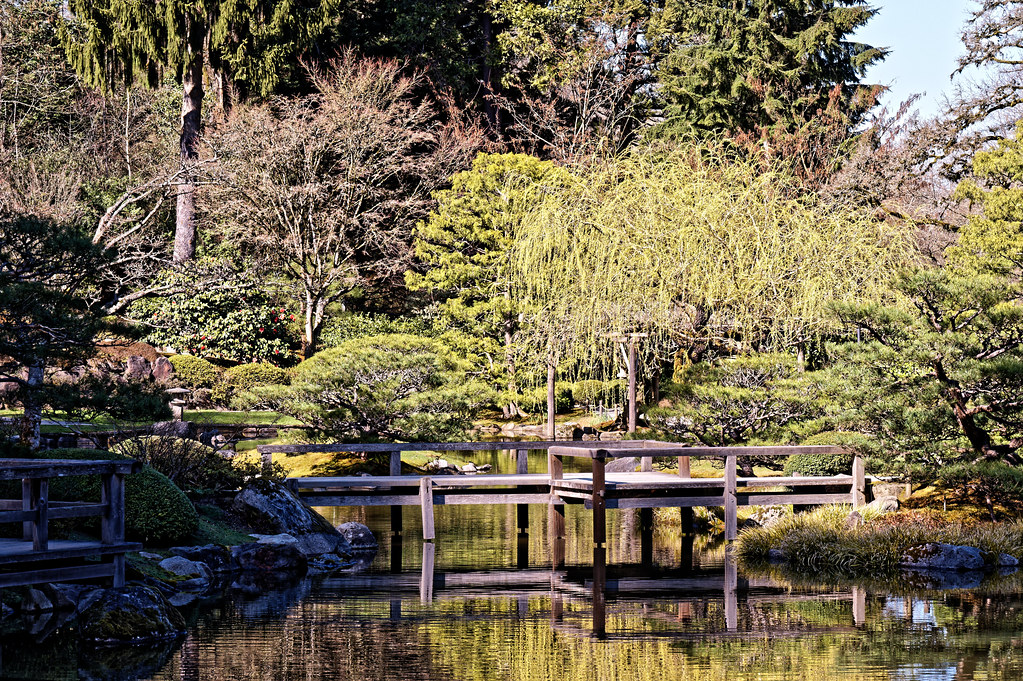
There is a moment, maybe thirty seconds after you step through the wooden gate at the Seattle Japanese Garden, when the city simply disappears. The traffic on Lake Washington Boulevard fades. Your shoulders drop an inch. You exhale. And then you notice the koi — big, slow, impossibly orange — drifting just below the surface of the central pond like living embers, and you think: how did I not know this place existed?
Tucked into the southern end of the Washington Park Arboretum in the Madison Valley neighborhood, the Seattle Japanese Garden has been one of the city’s most quietly extraordinary secrets since it opened in 1960. Designed by Juki Iida, one of Japan’s most celebrated landscape architects, the 3.5-acre garden was modeled on the strolling gardens of the Edo period — spaces built not just for beauty, but for contemplative movement. You are meant to walk slowly here. You are meant to look twice at everything.
The design rewards that patience in layers. A sculpted hill rises at the garden’s heart, shaped to suggest a distant mountain when viewed from the teahouse veranda. Stone lanterns appear at intervals along the gravel paths, each one positioned to cast a specific shadow at a specific hour. The seasonal plantings shift from the pale pink drama of cherry blossoms in early spring, through the deep summer green of Japanese maples and bamboo groves, all the way to the blazing amber and scarlet of autumn foliage — which, frankly, rivals anything New England has to offer.
The teahouse itself, a traditional shoin-style structure that sits at the garden’s edge, hosts public tea ceremonies on select weekends throughout the year. These are not tourist performances — they are calm, careful rituals led by practitioners trained in the Urasenke tradition. Watching a bowl of matcha prepared with that level of focused attention has a way of recalibrating your own sense of time. I left feeling genuinely refreshed, in a way that a double espresso never quite manages.
Admission is modest — just a few dollars for adults, less for seniors and students, and free for children under five. The garden is open from April through November, and if you can go on a Tuesday morning when it first opens, you may have the paths nearly to yourself. Bring a book, or don’t. Sit on one of the stone benches near the pond and watch the herons. Let the architecture of the place do its work.
Seattle has no shortage of spectacular outdoor spaces, but this one operates on a different frequency. It asks you to slow down, and it gives you every reason to. That is rarer than it sounds.

