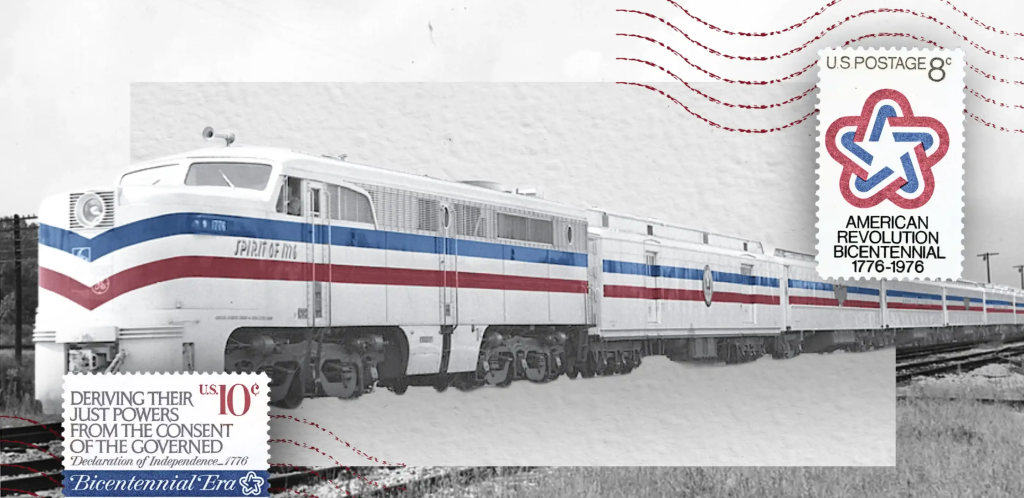
It’s the summer of 1976. Americans crowd along train tracks to wave as a white train emblazoned with bright red and blue stripes rolls across the United States. Hundreds flock each stop for the chance to climb aboard the Freedom Train in honor of America’s bicentennial year.
Stepping through the entry car, citizens find themselves carried along a moving pathway through United States history. More than 20 train cars each exhibit documents and artifacts highlighting a unique element of the American story, from wartime trials and triumphs to inventions, art, and sports. In some cars, recorded audio narrates the scenes. In others, mechanical replicas of historical figures captivate audiences with stories of patriotism.
At the bicentennial, America celebrated the nation’s 200th anniversary against the backdrop of Saigon, Watergate, and a broader crisis of confidence in public institutions. Fifty years later, the country is preparing to mark another historic milestone. The commemorations of 1976 offer a glimpse into how the anniversary encouraged the spirit of American freedom to animate the nation during a time of political and social tension.
In anticipation of the nation’s 200th anniversary, the American Revolution Bicentennial Administration (ARBA) commissioned Chermayeff & Geismar Associates to design a logo — a star formed of red, white, and blue ribbon. This year, America250 engaged the same organization to design the semiquincentennial logo which uses the same patriotic ribbon to form the number “250.”
Beyond the logo and Freedom Train, ARBA’s focus was supporting state and local bicentennial activities, reporting that more than 90% of Americans participated in at least one bicentennial-related activity.
Local celebrations emphasized art, heritage, and patriotism. Community theaters produced revolutionary themed plays, such as the classic musical “1776.” Schoolchildren participated in reenactments of scenes from the War for Independence and the Constitutional Congress. Towns restored historic buildings to preserve the memory and beauty of their past. In New York, “Operation Sail” brought a fleet of tall ships into the harbor.

Footage from the time shows smiling American families building stage platforms, waving American flags, and singing patriotic tunes. Man-on-the-street interviews repeatedly capture citizens with alluring transatlantic accents declaring the festivities “just grand” as they comment on the unity and peace brought about by the celebration.
Christians also engaged in the events, passing out tracts in crowds and calling for the nation to return to its historic roots of faith. At “Freedom Celebration 1976,” an event resembling the recent Rededicate 250, thousands of Americans gathered at historic Constitution Hall in Washington, D.C., to pray for the nation. Esteemed radio and television hosts Carl Richardson and Jerry Noble led the attendees in remembering the Christian heritage of America and praying for a revival.
While ARBA organized the national Freedom Train, volunteers from around the nation were organizing a train of their own: the Bicentennial Wagon Train Pilgrimage.
In the manner of the pilgrims who settled the West, a traditional covered wagon set out from each of the contiguous states, heading east along historic settlement trails in a reverse replay of history. The first wagon departed from Blaine, Wash., on June 8, 1975, to lead one of four wagon trains heading toward Pennsylvania.
Along the way, the wagon train collected written pledges from states, communities, and individuals alike pledging to “dedicate ourselves anew” to the precepts enshrined in the preamble to the Declaration of Independence. The pledges were meant to be sealed in a time capsule and opened in 2076. Yet records conflict over whether the capsule was ever assembled, leaving the whereabouts of the documents uncertain.
The wagon trains also mobilized local communities by hosting school groups at campsites, joining town parades, and encouraging civic pride.

President Ford initiates ringing of the bicentennial bells.
The event culminated with the convergence of the wagon trains at Valley Forge, just northwest of Philadelphia, on July 4, 1976 — exactly 200 years after the Declaration of Independence was originally signed. President Gerald Ford recognized the pilgrims with an address as they honored the history of America and celebrated the nation’s continued dedication to the spirit of the founding.
Numerous other high-profile events accentuated the anniversary. The Smithsonian Institution opened the Air and Space Museum on July 1. Billy Graham and Bob Hope chaired an “Honor America” gathering at the Kennedy Center. International actors graced the scene with gifts and visits, including a prominent stay from Queen Elizabeth II of England.

President Ford dancing with Queen Elizabeth.
In one address, Ford spoke on the Christian roots of the nation.
“There is no part of our past more important than our spiritual heritage — and there is no firmer foundation for the years to come,” Ford said. “We have been, and we will remain, one nation under God.”
In 2026, as the semiquintentennial approaches, America once again faces a season of political distrust, with confidence in government, the media, and major institutions remaining strained after years of polarization and public disillusionment.
Against this backdrop, the United States has stepped up with displays of national pride and unity.
Two different federal bodies have crafted a range of events to celebrate America’s semiquincentennial anniversary. America250, a nonpartisan organization established by Congress in 2016, emphasizes local block parties and the “Give 4th” movement while Freedom 250, a task force established by President Donald J. Trump, focuses on national events like the Great American State Fair.
Some of the semiquincentennial festivities resemble those of 1976. The Freedom 250 Mobile Museums follow the model of the Freedom Train, Rededicate 250 reflected Freedom Celebration 1976, and the tall ships will be returning to New York Harbor on July 4. Just as the Air and Space Museum opened at the bicentennial, the Teddy Roosevelt Presidential Library is set to open during the semiquincentennial. For both anniversaries, the Department of the Treasury issued collectable coins, and the U.S. Postal Service issued a series of commemorative stamps.

Freedom Train postcard
Other events uniquely highlight national unity. Freedom 250 is inviting everyone to the National Mall to enjoy a day of classic fair activities at the Great American State Fair. The initiative is also hosting a FIFA World Cup “fan zone” to encourage national pride as citizens come together to cheer for soccer teams, while the upcoming Patriot Games offers a platform for good-natured state-versus-state competition.
America250’s website hosts an active map of all semiquincentennial events across the country as the organization encourages citizens to plan and attend local block parties. On July 4, a time capsule containing artifacts from every state in the union will be buried in Independence National Historical Park, set to be opened in another 250 years. July 4 will also mark the end of Flag Sojourn 250, a year-long journey of one American flag to every state, territory, and U.S. military cemetery overseas.
In keeping with American tradition, the celebrations will culminate in a nigh of fireworks on Independence Day. The sky will light up over the National Mall, New York Harbor, and backyards across the nation. The “bombs bursting in air” remind citizens of the battles fought on American soil to secure their freedom as they celebrate the country’s continued affirmation “that all men are created equal, that they are endowed by their Creator with certain unalienable Rights.”
For 250 years, America has remained a strong nation dedicated to Judeo-Christian values. The festivities of the bicentennial exemplify a spirit of unity and freedom that preserves the nation for future generations to enjoy the rights of free people for centuries to come.
“The sum of the whole matter is this, that our civilization cannot survive materially unless it be redeemed spiritually.”
— Woodrow Wilson in his final essay before his death, published in 1923 in “The Atlantic Monthly.”