Illustration (AI-generated).
It is here.
For months, a battle has been brewing to save Texas from corporate oligarchs thrusting AI data centers, BESS sites, 765 kV transmission lines and wind farms on the Lone Star State. Now it has reached a breaking point, and the winner may well be determined by what happens in this election.
On one side of the battlefield: companies and organizations like BlackRock, Black Mountain, Meta, Google and Oncor, to name a few. Leading the charge: Governor Greg Abbott. These mammoth corporations are determined to devour our farmland for wind and solar farms, litter our ranch land with massive 765 kV transmission lines, add toxins to our pristine aquifers and harmful nitrogen oxides to our clean air, while pretending it’s for our own good.
On the other side of the battlefield: the citizens of Texas. Leading the charge: the grassroots groups rural Texans have formed in every corner of the state – Republicans, Independents, Democrats and Libertarians; Black, Anglo, Latino, Asian and Native American – united to fight these industrial developers.
Listen to the stories of hard-working Texans crushed by the maneuvers of these corporate titans.
From the pecan farmers in El Paso. Their well water is being drained by an AI data center, with more facilities on the way. They are being quietly pressured to cap their wells. But it’s okay, they’re told, “You can access new water sources from the AI developers.”
From the people of Childress, who tell me they have no affordable homes left for their own citizens. When 4,000 to 5,000 data center construction workers arrived “all at once,” as the mayor put it, rents at one complex doubled to as much as $2,000 a month. Then, in September, drought and heat left the town without safe tap water.
From the people of Red Oak, desperately trying to save the pristine open land next to them from being transformed into an industrial wasteland.
From the Burnet County folks who fear their karst* geology could give way beneath the monstrous 765 kV transmission lines planned for their area.
From the citizens of Temple, who report they have lost control of their water to an AI data center developer. Under the city’s own rate schedule, the large-volume industrial user pays $3.20 per thousand gallons for clean, treated water. Everyone else pays $3.95. Seventy-five cents less for industry than for the families who live there.
From the people of Hood County, where developers have proposed eight data centers on more than 7,600 acres, about 12 square miles. And from landowners across Texas, where more than 70,000 acres will be littered with 765 kV transmission lines.
From the ranchers of the Edwards Plateau in West Texas, who are fighting a proposed hydrogen plant that would cover about 47 square miles of ranchland with wind turbines and solar panels and pump water from the Edwards-Trinity Aquifer. Now they’re fighting the 765 kV lines that would open the door to more wind and solar. Read more: San Angelo LIVE, “Hydrogen Hubs Threaten to Drain West Texas of Water”
From Rachel Streater in Leon County, who watched the farm and ranch land next to her family’s property near Marquez, and pines more than 30 years old along her fence line, bulldozed for a 1,300-acre solar farm. “Noise pollution by day, light pollution by night,” she says.
From the citizens of Granbury, tormented by the constant roar of a bitcoin mine, who have reported migraines, vertigo and hearing loss.
From the people of Corpus Christi, where refineries and chemical plants use about 60% of the region’s water, the Governor has threatened a state takeover of their city, and residents have spent a decade fighting a $1.2 billion desalination plant they say serves industry, not families. When did we agree to let the state take custody of our water?
From Lowell Williams, a third-generation rancher near Blum in Hill County, whose 700-acre working cattle ranch sits less than 50 feet from a data center that is going “full steam ahead.” He built houses so the fourth and fifth generations could live on the ranch. “They’re gonna kill my property value. They’re going to kill my animals. They’re going to kill my way of life… and my legacy.” Hill County tried to pause data centers in May, then dropped the pause after a developer sued for more than $100 million. Watch him tell his story: facebook.com/share/r/1CWGnXoGmd or scan the QR code below.
What legislator can hear these heart-wrenching stories and continue to do nothing about it?
My heart bleeds Republican red but something is terribly wrong when giant corporations are blatantly served at the cost of the people.

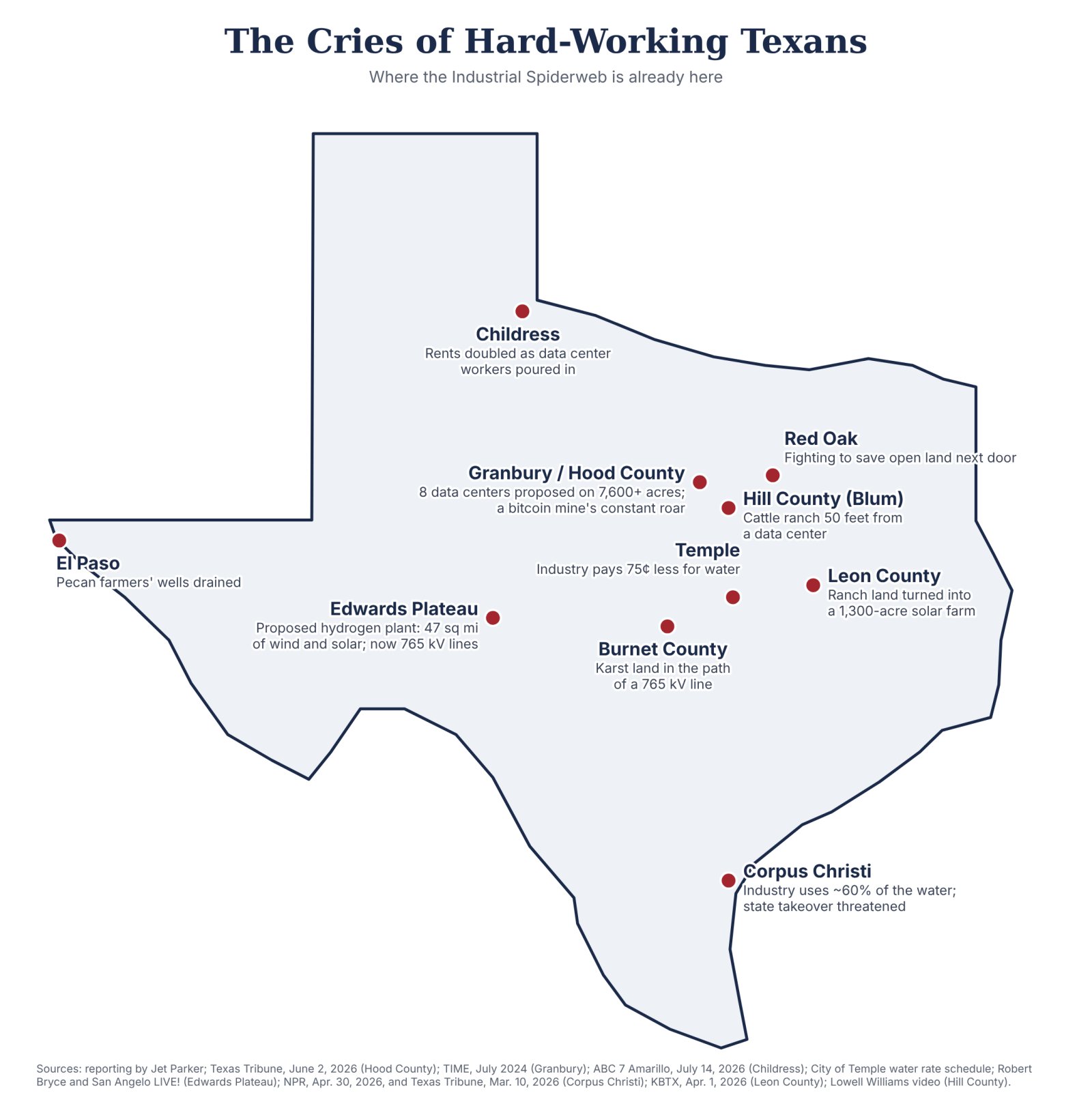
The Industrial Spiderweb is already here.
Grassroots groups across Texas have pleaded, petitioned, called, emailed, protested and testified to get our legislative leaders to call a special session to address their concerns BEFORE the election. Their requests are not unreasonable. They want to stop the accelerated, unchecked expansion of this industry and set up safeguards, infrastructure and legislation to protect their resources and preserve their way of life.
But our leaders refused.
Why?
Here’s why. These companies are in a race. They believe whoever builds the most computing power first, wins. So, what they want most is speed, and we’ve made it so easy for them.
Texas is where you can build fast. Cheap land. Plenty of natural gas. Counties with no power to zone them out. A state that told data centers to report their water use by March 1, then shrugged when seven in ten didn’t answer. And a government that PAYS them to come, with tax breaks.
If you remember nothing else, remember this: Texas isn’t being targeted. It’s being used, because it has the fewest brakes.
The damage to our independence is a byproduct that nobody in the deal is paid to care about. And what is our independence made of? Our own water supply. Our own food. Our own grid. Our own energy.
Now look at what they are asking for:
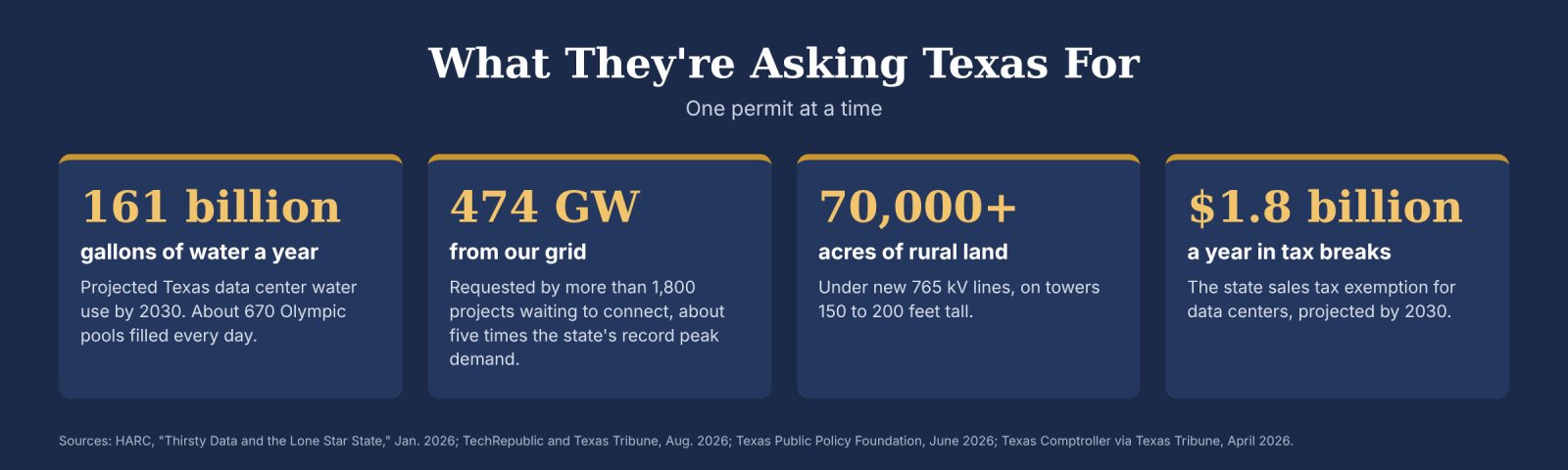
What they’re asking Texas for.
Did you know Texas has lost nearly 3.7 million acres of working farm and ranch land in the last 25 years?
That is how a state loses its independence. Not in one vote. One permit at a time.
Not a free market
Our energy market in Texas is not a free market, because federal subsidies on wind and solar generation help decide what gets built. If it takes a federal subsidy to get built, the market didn’t choose it. Taxpayers get stuck with it.
Those federal credits are now being phased out, but the guaranteed money is going someplace else: transmission lines.
The PUC has already approved nearly 800 miles of 765 kV lines – part of a plan that, with related upgrades, would cost about $33 billion to build and put more than 70,000 acres of rural land under easements. The Texas Public Policy Foundation says the lifetime cost is close to $100 billion, including about $25 billion in projected returns to the companies building them. That is not a market outcome. It is a guarantee, paid by you, on your electric bill.
And who owns those companies? Among their largest shareholders are Vanguard, BlackRock and State Street, three of the four biggest money managers in the world, which together manage more than $30 trillion.
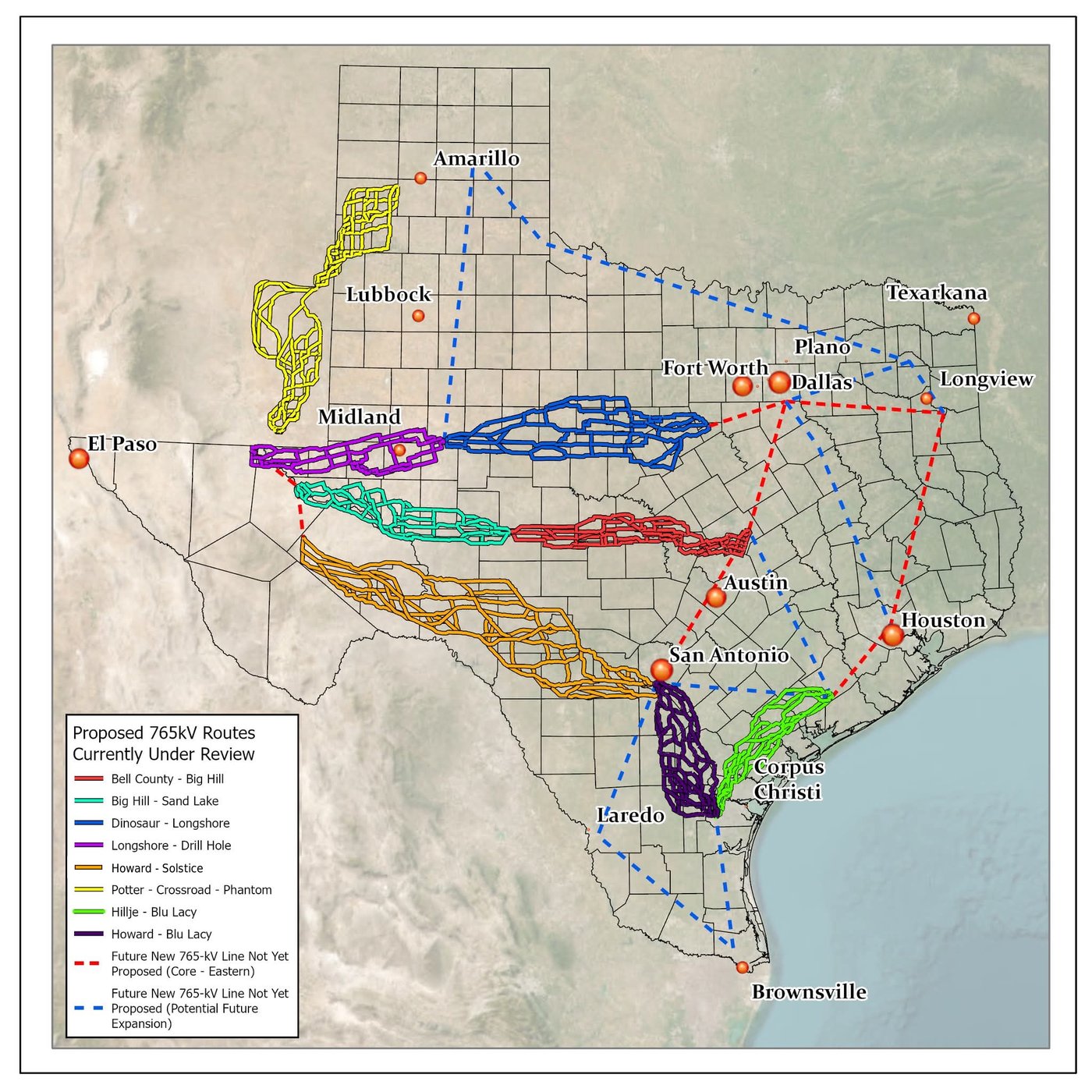
Proposed 765 kV routes, some still in study and not yet filed with the PUC. Map: Jessica Vee, landowner.
Follow the money
Follow the money, and the picture gets clearer.
-
The Governor appoints all five Public Utility Commission members, the people who approve every 765 kV line.
-
He appoints one of the three people who choose ERCOT’s board.
-
His former chief of staff, Luis Saenz, has sat on Oncor’s board since 2023.
-
His current chief of staff, Robert Black, came straight from ERCOT, where he was vice president of public affairs while ERCOT prepared the Permian Basin plan that brought back 765 kV lines. Before ERCOT, he was a vice president at AEP Texas, another utility.
-
Sempra, a California company, owns 80.25% of Oncor, the state’s largest builder of these lines. In 2025, Sempra’s Texas utility business, built around Oncor, earned $861 million – nearly half of Sempra’s reported earnings.
-
On a call with Wall Street analysts in November 2025, Sempra’s own CEO said the company brought its board to Dallas and had “Governor Abbott come join the Sempra board in a private three-hour dinner” while it studied Oncor’s growth plans.
-
Oncor’s PAC and executives gave the Governor $365,000 in just four months of 2026, including $170,000 from Oncor’s CEO, Allen Nye, and his wife, according to E&E News.
-
In April 2026, the PUC set Oncor’s authorized return on equity at 9.75% and approved a $560 million yearly revenue increase. Paid on your electric bill.
And in early October, the industry launched the Lone Star Infrastructure Coalition to tell “the economic story.” Its members include Oncor.
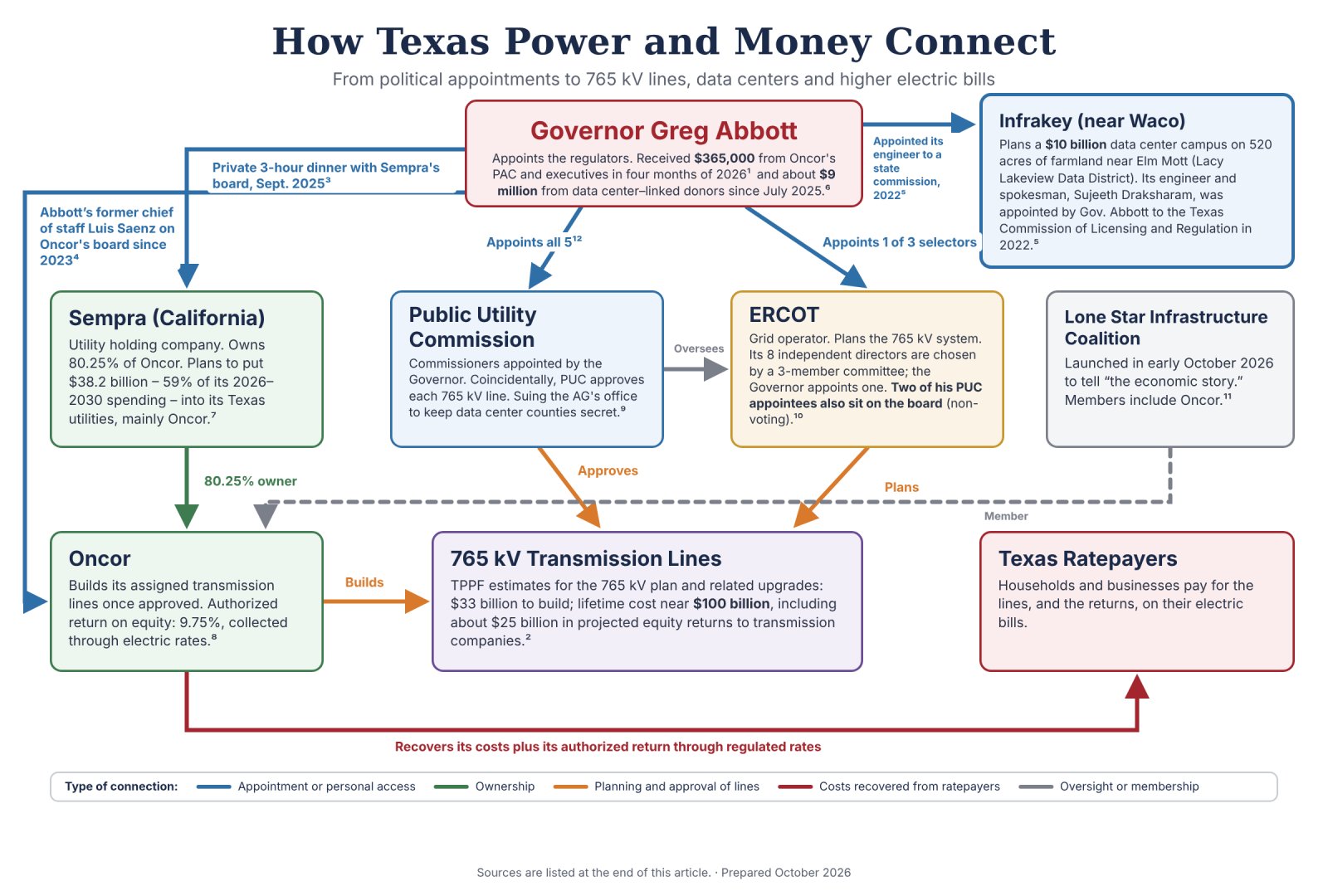
How Texas power and money connect.
A higher authority
Governor Abbott may have the money, the political machinery and powerful corporate interests behind him, but the people answer to a higher authority. The machine is no match for the faithful.
That is not arrogance. It is God’s word: “Not by might nor by power, but by my Spirit,” says the Lord Almighty. Zechariah 4:6.
My faith teaches me that earthly power is stewardship, not ownership, and that every leader is accountable to God for how that power is used.
So I will stand firm with the belt of truth that some don’t want to hear; the breastplate of righteousness that defies a machine that has forgotten who it serves; the shield of faith that tells me the humble civic leader stays loyal to the people first and the party second; and the courage to use the voice and the vote God gave me to stop the industrial wrecking ball demolishing what is the best of the Lone Star State.
The people of Texas deserve pre-election protection – legislation, infrastructure and safeguards – to properly preserve what they value, not what the oligarchs want. Private property is not a privilege the state grants. It is a right the Texas Constitution protects – and a trust God placed in our hands.
I have repeatedly told my party: don’t underestimate the will of fiercely independent Texans who are being stripped of what they value most: their land, water, cattle, farms, property rights, wildlife, health, peace and scenic views. They have made it clear to our collective organizations, they will vote differently in November: some for Jenn Mack, the conservative independent write-in candidate running for governor; some for Gina Hinojosa, the Democratic candidate running for governor. Why ignore such a critical voter base right before an election?
Empty promises
Texans are tired of empty promises that just run out the clock until the election is over.
-
The pause. On August 3, the Governor paused new data center connections to the grid and ordered an audit. But the pause covered only the biggest projects, those over 75 megawatts. More than 150 mid-sized projects, every small one, and every data center that builds its own power plant were left out. On September 21, he told the state’s environmental agency to stop issuing data center permits until the audits are done. But an order isn’t a law. It carries no penalty, it doesn’t stop local tax abatements, and it can be reversed the day after the election. And the very next day, TCEQ mailed preliminary approval notices for three gas power plants tied to data centers – among 35 actions that kept projects moving after the “pause.” On Oct. 22, it suspended at least 17 permits it had issued after the order.
-
The fine print. On June 30, the Governor promised to “prohibit them from building AI data centers in rural Texas neighborhoods.” Not rural Texas. Neighborhoods. Our ranches, farms and open land, where these sites are actually going, aren’t in the promise. And there is still no ban, no order and no bill.
-
The dodging. That water survey was due March 1, more than seven months ago. The Governor didn’t threaten penalties until September 14.
-
The secrecy. His own Public Utility Commission is suing the Attorney General’s office to keep the public from learning which counties the data centers are in. He appointed every commissioner. He could ask them to drop the lawsuit and share the information.
-
The 765s. The companies building them collect guaranteed returns on your bill. He could turn that faucet off. He hasn’t.
-
The promise. The Governor says “Texans must come first” and promised to end all financial incentives for data centers. Good. Then put it in law – and make it the first thing the 90th Legislature does when it convenes on Jan. 12, 2027.
Unfortunately, these offerings are like baby teeth: disposable. They just run the clock down.
Give us something with teeth, Governor Abbott.
The clock runs out on Election Day, Nov. 3.
Go to the Save Rural Texas website, www.saveruraltexas.com, and review your voting options. If you are leading a grassroots group fighting the Industrial Spiderweb, contact Save Rural Texas at [email protected] for help.
*Karst: ground made of limestone or similar rock that water has slowly dissolved into caves and underground channels. The ground can give way and form sinkholes, and pollution on the surface can reach the aquifer below quickly. Learn more from the U.S. Geological Survey: https://www.usgs.gov/mission-areas/water-resources/science/karst-aquifers
Jet Parker is a CEO, author and founder of CEO Wired and co-founder of Save Rural Texas. Guided by faith and the Constitution, she has spent more than 30 years building companies, advising leaders and defending Texas communities.
Sources
Hood County: “Eight data centers threaten to transform this small Texas county,” Texas Tribune, June 2, 2026.
Childress: ABC 7 Amarillo, July 14, 2026 (workers, rents); NewsChannel 10, Sept. 12, 2026, and Spectrum News, Sept. 16, 2026 (water emergency).
Leon County (Rachel Streater): “Large-scale solar farm transforms rural Leon County landscape,” KBTX, April 1, 2026 (Repsol’s 595 MW Pecan Prairie Solar Facility, 1,300 acres of former farm and ranch land).
Lowell Williams: his video statement, shared on Facebook. Hill County moratorium: KWTX, July 15, 2026.
Edwards Plateau: Robert Bryce, “Invasion of the Water Snatchers” (ET Fuels’ Tierra Alta project, Schleicher County); San Angelo LIVE!, “Hydrogen Hubs Threaten to Drain West Texas of Water,” Aug. 20, 2024.
Corpus Christi: NPR, “Corpus Christi faces a severe water shortage,” Apr. 30, 2026 (industry’s 60% share); Texas Tribune, Mar. 10, 2026 (takeover threat); Texas Public Radio, Oct. 13, 2026 (desalination plant cost and opposition).
Granbury: “‘We’re Living in a Nightmare’: Inside the Health Crisis of a Texas Bitcoin Town,” TIME, July 2024.
Temple: City of Temple water and wastewater rate schedule, industrial large-volume user vs. all other classes.
Water reporting: Foley & Lardner, Sept. 2026; KUT News, June 26, 2026.
Water projection: HARC, “Thirsty Data and the Lone Star State,” Jan. 2026. Grid requests: TechRepublic, Aug. 5, 2026. Tax breaks: Texas Tribune, April 8, 2026.
Working land lost: Texas A&M Natural Resources Institute, Status Update and Trends of Texas Working Lands, 1997–2022, Feb. 2025.
765 kV costs and acreage: Texas Public Policy Foundation, “An Economic Assessment of the 765-kV Strategic Transmission Expansion Plan,” June 2, 2026.
Shareholders and assets under management: Yahoo Finance; Investing.com; company profiles.
Sempra dinner: Sempra Q3 2025 earnings call, Nov. 5, 2025 (transcript, The Motley Fool).
Luis Saenz: Oncor Board of Directors page.
Robert Black: Office of the Governor, “Governor Abbott Names Black As Chief Of Staff,” July 1, 2024; ERCOT’s July 2024 Permian Basin plan filing: Texas Reliability Entity, May 2025.
ERCOT board selection committee: Texas Utilities Code §39.1513.
Oncor contributions: E&E News, “Oil, electric cash fuels Texas GOP campaigns,” July 20, 2026. Oncor’s return and rate increase: PUC final order, Docket 58306, April 17, 2026 (Sempra Form 8-K). 765 kV approvals: Texas Policy Research, Aug. 28 and Sept. 16, 2026. TCEQ actions after the pause: FracTracker Alliance, Oct. 19, 2026; KUT, Oct. 20, 2026; Public Citizen, Oct. 22, 2026. Sempra ownership and earnings: Sempra, “Sempra Reports 2025 Financial and Business Results,” Feb. 26, 2026.
Lone Star Infrastructure Coalition: Texas Scorecard, Oct. 6, 2026.
Governor’s orders: Office of the Texas Governor, Aug. 3, 2026; Texas Tribune, Sept. 21, 2026.
PUC lawsuit: Texas Tribune, Oct. 6, 2026.