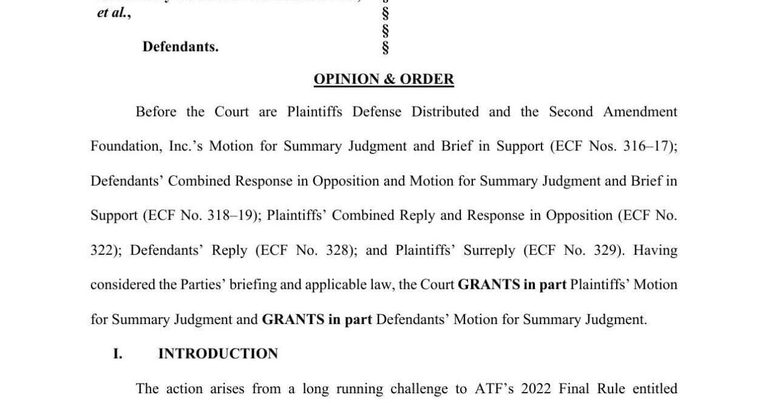
In a decision that could affect gun manufacturers and hobbyists nationwide, Chief U.S. District Court Judge Reed O’Connor of the Northern District of Texas granted summary judgment to Defense Distributed and other plaintiffs, striking down the Bureau of Alcohol, Tobacco, Firearms and Explosives’ 2022 rule that broadened the definition of a firearm.
Rule at issue
The ATF rule, titled “Definition of ‘Frame or Receiver’ and Identification of Firearms,” expanded the legal definition of a firearm to include partially manufactured frames and receivers—often sold as 80% completed kits—and parts kits that could be readily finished to fire a projectile. The agency argued the change was needed to address so‑called “ghost guns.”
Plaintiffs’ challenge
Defense Distributed, a company that sells 80% lower‑receiver blocks and assembly kits, sued the agency, arguing the rule infringes on the constitutional right to keep and bear arms and fails to give clear notice of what is prohibited. The case, originally filed as VanDerStok v. Garland and later renamed Defense Distributed v. Blanche, also touches on the agency’s authority under the Administrative Procedure Act.
Judge’s findings
Judge O’Connor wrote that the rule’s language—determining when a “hunk of metal or plastic may readily be completed, assembled, restored, or otherwise converted” into a functional frame or receiver—relies on a “subjective determination of the ATF” and provides no fair notice to the public. He concluded the rule is unconstitutional under the Second Amendment and void for vagueness under the Fifth Amendment’s Due Process Clause.
While the judge found the ATF rule unconstitutional, he granted the government’s motion for summary judgment on the plaintiffs’ claims under the Administrative Procedure Act, leaving that portion of the case unresolved.
Reactions
Adam Kraut, executive director of the Second Amendment Foundation, praised the decision, saying the rule would have chilled lawful gun ownership by making it impossible to know what was legal. Conversely, Everytown Law’s executive director Eric Tirschwell called the ruling “egregiously wrong” and said the Justice Department will appeal, noting that the Supreme Court’s VanDerStok decision already requires background checks and serial numbers for most ghost‑gun kits.
What the order does
The court issued a declaratory judgment that the ATF rule is invalid and enjoined the government from enforcing the challenged sections against Defense Distributed, SAF, or any of SAF’s current or future members concerning specific 80% frames, build kits, unfinished receivers, and grip modules.
The ruling adds to ongoing legal battles over how far the federal government may regulate firearm components and highlights the tension between public‑safety objectives and constitutional gun‑rights protections.
Original reporting: KTBS 3 (Shreveport) — read the source article.