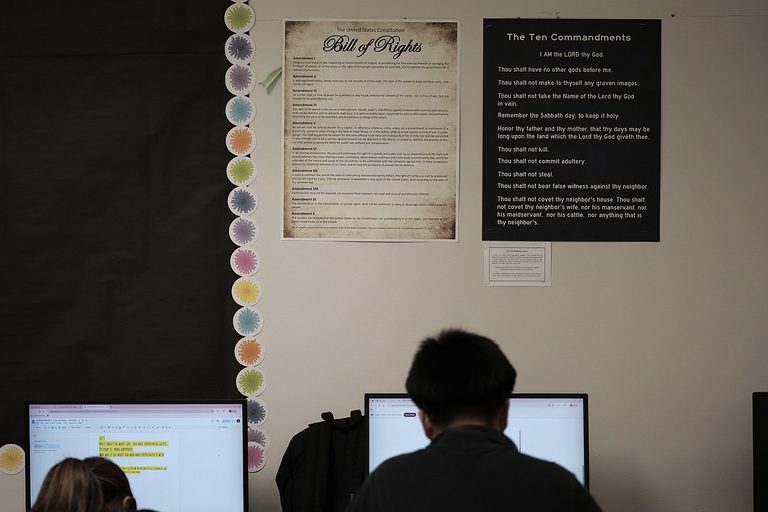
In a move that could reshape the balance between faith and public education, a coalition of Texas families has filed a petition asking the U.S. Supreme Court to hear a challenge to the state law that requires every public‑school classroom to display the Ten Commandments.
Background and recent court action
The law, signed by Governor Greg Abbott last year, was upheld earlier this year by the 5th U.S. Circuit Court of Appeals in New Orleans in a narrow 9‑8 decision. The appellate panel reversed a lower‑court ruling that had found the statute unconstitutional under the First Amendment’s establishment clause, which bars government actions that favor one religion.
Supporters of the law, including Texas Attorney General Ken Paxton, argue that posting the biblical code does not compel students to engage in a formal religious exercise and therefore does not violate the Constitution. Paxton said the Ten Commandments have “had a profound impact on our nation” and that students should learn from them daily.
Who is challenging the law
More than a dozen families of varied faith backgrounds filed the lawsuit after the law’s enactment. They are represented by the American Civil Liberties Union, the ACLU of Texas, and Americans United, an organization that defends the separation of church and state. In their petition, the groups contend that the permanent display of biblical scripture in classrooms interferes with parents’ right to direct their children’s religious education.
“If the permanent, unavoidable imposition of biblical scripture in public‑school classrooms does not interfere with, or threaten to undermine, parents’ ability to direct their children’s religious education… it is difficult to imagine what would,” the petition reads.
Legal context
The case arrives at a time when the Supreme Court’s conservative majority has broadened religious liberty protections. In 2022, the Court ruled that a high‑school football coach’s on‑field prayers were protected speech. More recently, the Court has sided with religious parents seeking to remove LGBTQ‑focused curriculum and has allowed religious schools to participate in voucher programs when secular schools do.
The Fifth Circuit’s majority relied on the 2022 decision, applying a historical‑test framework: would people at the nation’s founding view the Texas law as a constitutional violation? The judges answered no, noting the law does not dictate worship practices, does not tax clergy, and does not punish those who reject the Commandments.
Related lawsuits and state actions
Three Houston mothers have filed a separate suit claiming the law conflicts with Texas’s own religious‑freedom statute and a parental‑rights amendment. Arkansas and Louisiana have enacted similar classroom‑display requirements, though Arkansas’s law has been blocked by a federal judge.
Other states have pursued Bible‑influenced curricula or appointed chaplains as school counselors. The Trump administration, in early 2025, issued guidance permitting designated prayer time in public schools.
What’s next
The Supreme Court will decide in the coming months whether to grant certiorari. If the Court takes the case, it could become a landmark decision on the separation of church and state in public education, affecting not only Texas but any state with similar statutes.
For now, the families and their legal advocates await the Court’s response, while supporters of the law continue to champion the display of the Ten Commandments as a moral foundation for students.
Original reporting: Texarkana Gazette — read the source article.