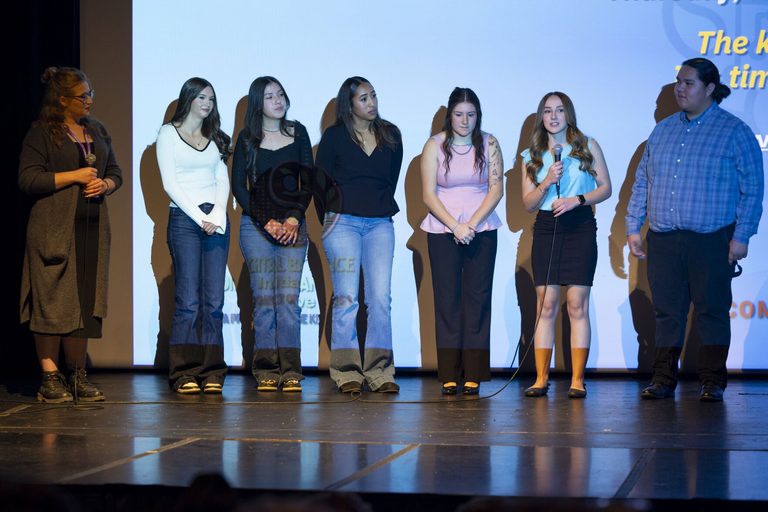
Taos County high school students and their families met on Nov. 12 at the Taos Center for the Arts for the first‑ever AI Family Night, organized by True Kids 1, a local youth media nonprofit. The event, led by the organization’s Youth AI Committee, aimed to bring the growing conversation about artificial intelligence into living rooms across the county.
Students voice concerns about learning and character
“We grew up in a generation where technology and social media are a part of our everyday lives,” said senior Carissa Sanchez, a member of the AI Committee. “Now, with artificial intelligence becoming more advanced and accessible, it is changing the way we learn, think and interact with the world around us.”
Senior Ciara Lewis added, “As students, we see how AI can be helpful, but we also have to ask ourselves: Are we using AI to help us learn or are we relying on it so much that we’re losing the ability to think for ourselves?”
Survey data shows widespread AI use among youth
A June 2026 study by Common Sense Media found that 86 percent of children ages nine to 17 reported using AI for homework or entertainment, and 33 percent said they confided in AI for advice and emotional support. More than 40 percent said a parent or guardian had never discussed AI safety with them.
Documentary reveals student perspectives
The committee premiered a short documentary, “Taos County Teens and AI,” featuring interviews with 36 students from Taos High, Peñasco High, and Questa High. Participants expressed worries about AI’s impact on the environment, future job markets, cognitive development, social wellbeing, and academic integrity.
One student warned, “If we’re lacking the ability to actually think on our own about simple tasks, I think that’s when the quality of people’s character will start to diminish.”
Cheating concerns surface
Several interviewees admitted that peers use AI to complete “busy work” assignments. One student estimated, “I would say like 95 percent of kids at the school use AI to cheat and just do all of their homework for them.” Another confessed, “I used it to do my assignments the majority of the time, whenever the teacher is not around.”
Data from Pew Research Center (2026) shows nearly 60 percent of teens aged 13‑17 report using AI to cheat “very often” or “somewhat often.”
Calls for media‑literacy education
Junior Kamila King, also on the AI Committee, urged schools to teach media literacy around AI, comparing the technology’s rise to the introduction of Chromebooks half a century ago. “We should be able to talk to teachers, and if they want us to act a certain way, they should have to act the same way,” she said.
AI Code of Conduct introduced
Following the discussion, the committee presented an AI Code of Conduct designed to guide responsible and ethical use. The code prohibits claiming AI‑generated work as one’s own, sharing private information with AI, relying on AI for emotional support, and distributing unverified AI content. It does allow AI to create practice quizzes, explain difficult concepts, and proofread essays.
Committee member Kaylin Staley emphasized, “Just because we have access to something doesn’t mean we know how to use it responsibly.” The code also addresses deep‑fake threats, noting a 2019 Dutch study found 96 percent of identified deep‑fake videos were non‑consensual pornography, overwhelmingly targeting women.
Balancing technology with healthy habits
The evening concluded with a screening of the documentary “Screenagers: Generation AI,” which includes the tragic story of a 16‑year‑old who died by suicide after extensive ChatGPT conversations. The Youth AI Committee also launched the “Big Change” challenge, encouraging participants to modify or eliminate one unhealthy digital habit for seven days.
Madison Davis, youth media specialist for True Kids 1, clarified the event’s purpose: “It’s not about prohibition. It’s about balance. We all know that we’re going to be living with technology, media and social media, so it’s just working to create healthier relationships, not just for youth, but for all of us.”
Original reporting: Taos News — read the source article.