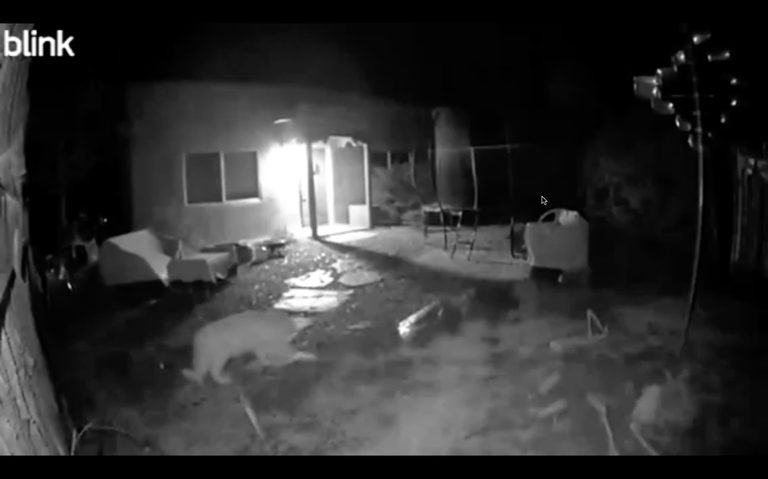
Late Friday, Nov. 13, a home security camera on Espinoza Road near Camino de Caballo captured a cougar walking through a Ranchos de Taos yard at about 10:45 p.m. Brandon Gephart, the homeowner, said it took his family a day to identify the animal.
Cougar sightings are not new to the valley
Cougars have been spotted in Taos town before. In the summer of 2023, videos surfaced of a cougar near Gutters Bowling Alley and at the Taos Haus apartments across from Albertsons, according to the Taos News at the time.
Francisco Cortez, a retired Carson National Forest wildlife biologist who has lived in the area all his life, explained that the Taos Valley is natural cougar habitat. “Through the years we’ve slowly encroached on where they used to live,” he said. “And so now we have to learn how to live with each other.”
Cortez added that modern technology makes encounters more visible. “We have cameras and our phones. We take a picture of it. Everybody hears about it,” he noted.
State guidelines for cougar encounters
The New Mexico Department of Wildlife clarified that a cougar on private property that does not pose an immediate threat may not be killed without an “over‑the‑counter” permit, and trapping is not a legal option. It is legal to shoot a cougar that is an active threat to people, property, livestock, or pets, but the kill must be reported within 24 hours before the carcass is moved.
To reduce the chance of an encounter, the department advises residents to avoid running or hiking at dawn and dusk, keep children close, bring pets indoors at night, feed pets indoors, and secure garbage. “Lions avoid people and normally see you before you see them,” Cortez said. Trouble usually starts when a dog chases one or when a female is protecting her cubs.
If a cougar is seen, the department recommends not running. Instead, face the animal, back away slowly, make yourself look as large as possible, and be prepared to fight back if attacked. “It’s just like a cat at home. You throw a ball of yarn — you don’t want to be that ball of yarn,” Cortez explained.
Historical context of cougar incidents
Attacks on people are rare. New Mexico has recorded two fatal cougar attacks in recent history. In January 1974, an emaciated 47‑pound female killed an 8‑year‑old boy in Arroyo Seco. The second fatality occurred in 2008 when a cougar killed a 55‑year‑old man at his home in Pinos Altos, near Silver City.
Across North America, about 30 people have been killed by cougars since 1868, according to the Mountain Lion Foundation. The most recent fatality was on Jan. 1, when a hiker was killed on a trail in northern Colorado, the state’s first fatal attack since 1999.
Management and hunting statistics
New Mexico paid bounties on cougars until 1970 and has managed the species as a game animal since the early 1970s, with hunting limits in place. The department’s latest estimate, from 2023, puts the adult cougar population in the state at about 3,500. Nationwide, an estimated 30,000 cougars live in the United States, most in the West, according to a 2024 Yale Environment 360 report.
The state’s cougar hunting season runs year‑round from April 1 to March 31, with each management zone closing once its limit is reached. In the season that ended March 31, hunters reported killing 290 cougars, well below the statewide allowance of up to 562 lions per season, including a cap of 174 females.
How to report a dangerous encounter
Anyone who believes a cougar poses a danger should call the Department of Wildlife’s Northeast Area Office in Raton at 575‑445‑2311 during business hours. After hours, contact the New Mexico State Police or the local county sheriff’s office.
Original reporting: Taos News — read the source article.