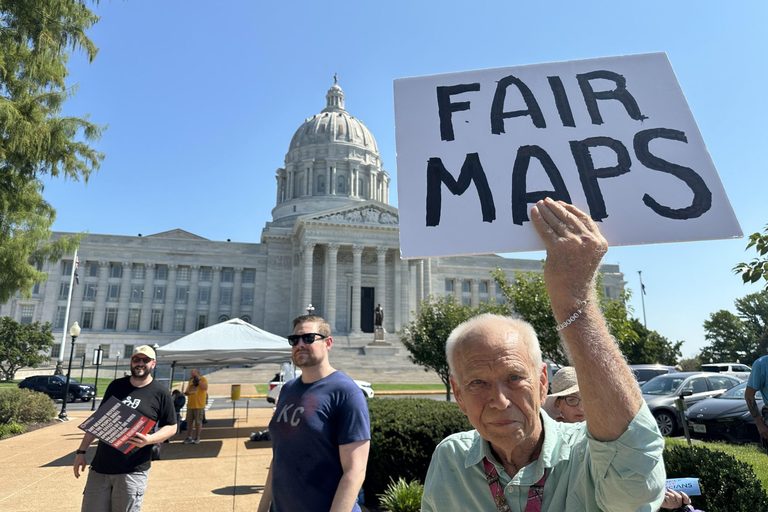
The United States Supreme Court on Tuesday denied an appeal from Missouri officials seeking to use a new congressional map that President Donald Trump publicly supported for the November 2026 election. By letting stand a decision of the Missouri Supreme Court, the high court effectively keeps the districts drawn after the 2020 census for the upcoming general election.
Background and legal basis
Missouri’s top court had ruled that the revised map was automatically suspended after a citizen petition called for a statewide vote on the changes. The court said the petition signatures, filed in December, froze the new districts retroactively, meaning they never became law. State Attorney General Catherine Hanaway argued that switching districts between the August primary and the November general election would violate federal voting rights and create confusion for voters.
Trump’s involvement and Republican strategy
President Trump urged Missouri Republicans to redraw the boundaries last year, and Governor Mike Kehoe convened a special legislative session to craft a map that would favor GOP candidates. The revised plan targeted the 5th Congressional District, currently held by longtime Democratic Representative Emanuel Cleaver of Kansas City, by moving portions of the city into neighboring Republican‑held districts and extending the remainder of Cleaver’s district into heavily Republican rural areas.
State Senator Rick Brattin won the Republican primary in the newly shaped district, while Rep. Cleaver ran unopposed in the Democratic primary. The Trump‑backed map was used in the August primaries, but the state Supreme Court’s September ruling required a return to the 2022 districts for the general election.
State officials’ response
Republican Secretary of State Denny Hoskins had earlier rejected a petition with thousands of signatures that sought a November referendum on the map, asserting that the Missouri Constitution does not permit a referendum on congressional redistricting. A lower court agreed, but the state Supreme Court reversed that decision, interpreting the constitution’s language on referenda to include redistricting legislation.
Following the high court’s denial of the appeal, Hoskins assigned the redistricting referendum as Proposition A on the November ballot, complying with the state Supreme Court order.
Implications for the 2026 midterms
The setback is a rare loss for Republicans in a nationwide redistricting push that President Trump encouraged last year. GOP leaders had hoped to gain up to 16 additional House seats from new maps in eight states, including Missouri, Texas, North Carolina, Ohio, Florida, Tennessee, Louisiana and Alabama. Democrats, meanwhile, anticipate the possibility of winning up to six extra seats from new districts in California and Utah.
While the Missouri decision limits the immediate impact of Trump’s redistricting plan, the broader effort continues in other states. The outcome also underscores the historical trend that the president’s party often loses seats in midterm elections, a factor that could present an additional hurdle for Republican candidates in Missouri and beyond.
What voters should know
Missouri’s U.S. House delegation will remain composed of six Republicans and two Democrats, all elected under the 2022 district lines. Voters will see the same districts on the November ballot, and the Proposition A referendum will allow Missourians to weigh in on whether future redistricting efforts should be subject to a statewide vote.
As the election approaches, both parties are expected to focus on messaging around local issues, family values, and constitutional freedoms, themes that resonate strongly with Missouri’s electorate.
Original reporting: Alexandria, VA News – WTOP News — read the source article.