There are places you visit, and then there are places that stay with you long after you’ve driven home. Lincoln’s Tomb at Oak Ridge Cemetery is firmly in that second category — and if you haven’t made the short trip north on Monument Avenue to stand in front of that 117-foot granite obelisk, you are genuinely missing one of the most moving experiences the entire Midwest has to offer.
Oak Ridge Cemetery sits in the northern reaches of Springfield, tucked into a landscape of rolling hills, ancient oaks, and the kind of quiet that city parks rarely manage to hold onto. The cemetery itself opened in 1860, and within a decade it had become one of the most visited sites in the country. That distinction hasn’t faded. Today, more than 100,000 people make the pilgrimage here every year — historians, families, school groups, solo travelers with a worn paperback biography in their back pocket — and every single one of them leaves with something they didn’t have when they arrived.
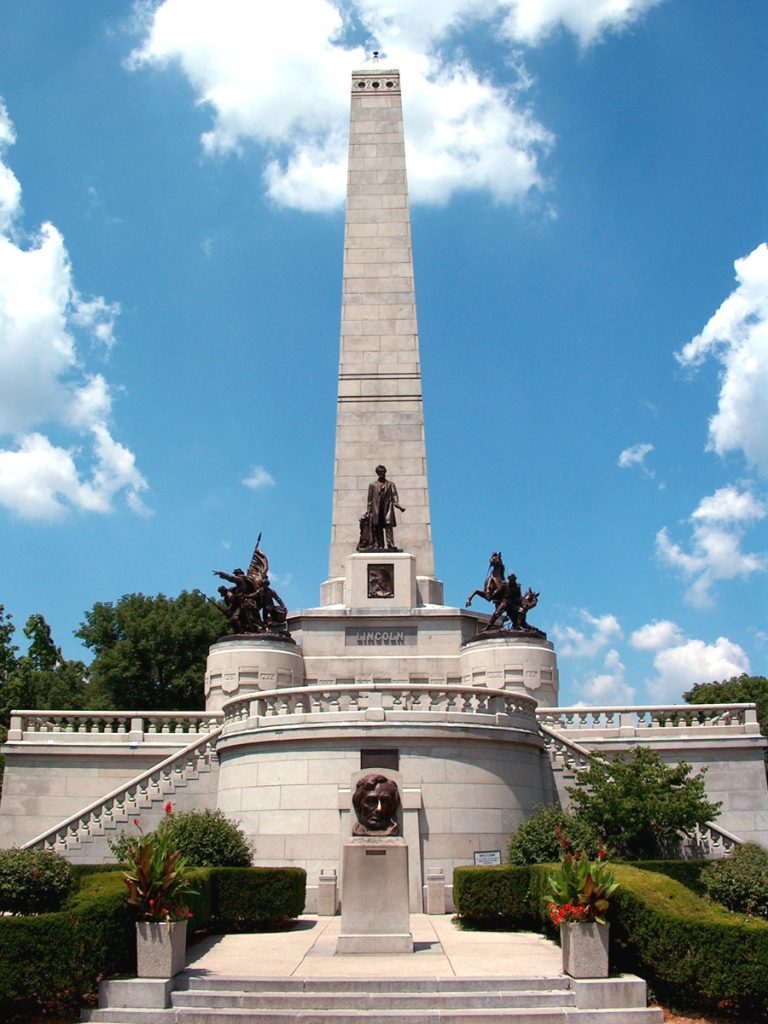
The tomb’s exterior is grand without being ostentatious. A soaring obelisk rises from a circular base flanked by bronze military groupings that represent the infantry, navy, cavalry, and artillery of the Civil War. At the north entrance stands a larger-than-life bronze bust of Lincoln himself, cast by Gutzon Borglum — the same sculptor who later carved Mount Rushmore. The nose on that bust is perpetually shiny and slightly worn, the result of generations of visitors rubbing it for good luck. You will absolutely rub the nose. Everyone does.
Step inside and the mood shifts entirely. The interior burial chamber is hushed and cool, lined with marble, and lit in a way that feels almost reverent. Lincoln’s original burial monument is here, along with the remains of Mary Todd Lincoln and three of their four sons. The tomb was reconstructed and reinforced in the early 20th century after structural concerns, and the interiors were restored again in the 1930s — yet the space never feels like a museum exhibit. It feels alive with history in a way that’s hard to articulate until you’re standing there yourself.
One practical note: admission is completely free, which makes this one of the finest no-cost afternoons in all of central Illinois. The tomb is managed by the Illinois Historic Preservation Agency, and the surrounding cemetery grounds are open to visitors year-round. Hours for the tomb interior run seasonally, so check ahead if you’re planning a winter visit. Spring and early fall are particularly beautiful, when the cemetery’s mature tree canopy turns the whole property into something out of a 19th-century landscape painting.
Before you leave, take a slow walk through the wider cemetery grounds. Veterans from the Revolutionary War through modern conflicts are buried here, and the grounds include a dedicated Illinois Governor’s Section as well as monuments to local soldiers and civic figures whose names deserve to be remembered. There’s a peaceful, unhurried quality to an afternoon spent here that’s increasingly rare and genuinely restorative.
Springfield has no shortage of Lincoln sites — it’s practically a full-time occupation keeping up with them — but the tomb stands apart. It is the end of the story, the final chapter, and somehow also a beginning: a reminder of what one life, dedicated to something larger than itself, can mean across centuries. Come ready to be moved. You will be.