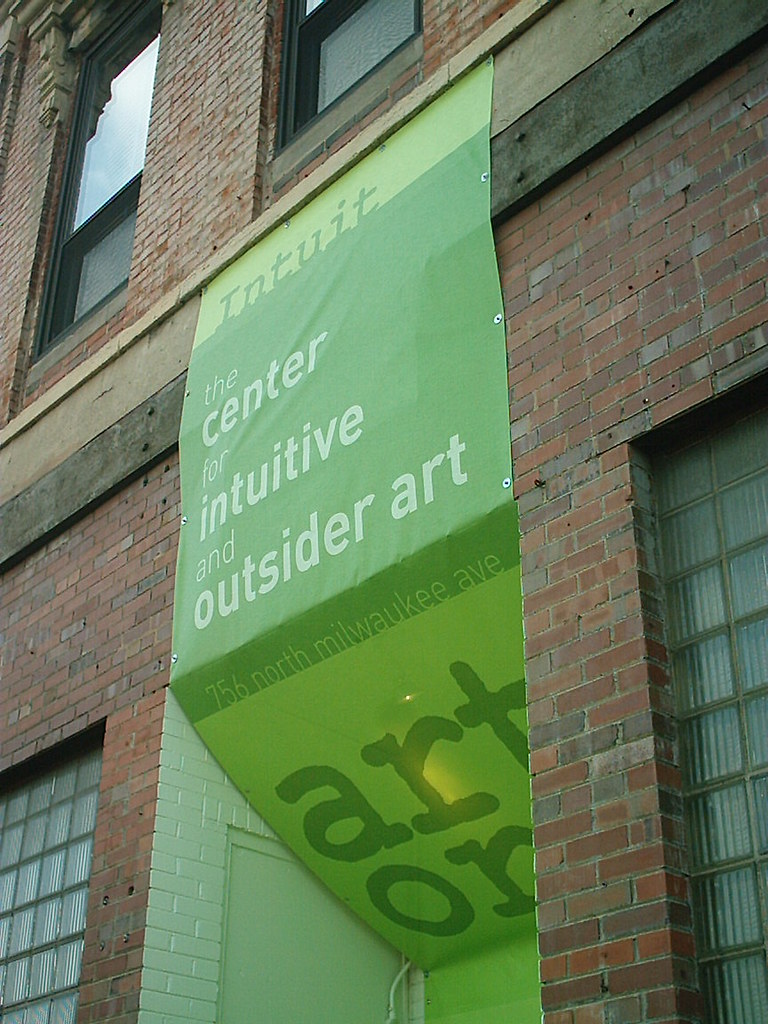
There is a particular kind of silence that settles over you when you walk into a gallery and realize you are looking at something made entirely outside the rules. No art school pedigree. No gallery system. No theory or trend chasing. Just one human being pouring an entire interior world onto canvas, paper, bottle caps, or whatever happened to be within reach. That is the experience waiting for you at Intuit: The Center for Intuitive and Outsider Art, tucked into Chicago’s vibrant West Town neighborhood at 756 N. Milwaukee Avenue.
Intuit has been championing self-taught and outsider artists since 1991, and in that time it has grown into one of the most quietly extraordinary cultural destinations in the entire city. The building itself is modest from the outside — you could walk past it if you weren’t paying attention — but step through the door and the scale of what has been assembled here becomes immediately clear. The permanent collection includes works by artists whose life stories are as compelling as the art itself: visionaries, eccentrics, survivors, and dreamers who created because they simply could not stop themselves.
The crown jewel of the collection is the Henry Darger Study, a meticulously reconstructed recreation of the actual room where Henry Darger — one of the most discussed outsider artists in history — lived and worked for decades on Chicago’s North Side. Darger spent his life as a reclusive hospital janitor and produced, almost entirely in secret, an illustrated novel running to more than 15,000 pages. The room feels startlingly intimate. His tools, his clippings, his paint jars — all of it preserved as though he just stepped out for a moment. Standing in that doorway, you feel the full weight of a life spent in devotion to an inner world nobody else ever saw.
Beyond the permanent collection, Intuit mounts rotating exhibitions that bring in work from across the country and beyond, ensuring that no two visits are quite the same. The curatorial eye here is sharp and generous. These are not novelty pieces propped up for curiosity’s sake. They are treated with the same seriousness and care you would find at any major institution in the city.
Admission is remarkably affordable — just five dollars for adults, and free for members and children under seventeen — which means this is one of those places you can visit again and again without any guilt whatsoever. The staff are genuinely enthusiastic and happy to talk through the work with you, which adds a warmth you don’t always find at larger institutions.
West Town is an excellent neighborhood to build a day around. Before or after your visit, wander along Milwaukee Avenue for coffee, lunch, or a browse through one of the independent shops nearby. The area has an easy, unhurried energy that complements a trip to Intuit perfectly.
If you have been searching for the kind of Chicago experience that lingers in your memory long after the weekend is over, this is it. Intuit reminds you that art is not a credential. It is a compulsion. And in the hands of the artists celebrated here, that compulsion produces work that is startling, moving, and completely unforgettable.