There is a moment, somewhere between standing beneath a four-story living rainforest and watching a penguin waddle past a tank of hypnotic jellyfish, when it hits you: this place is genuinely unlike anything else on Earth. The California Academy of Sciences, tucked into the western edge of Golden Gate Park in the Inner Sunset, is not just a museum. It is an experience that layered on top of itself again and again until someone finally said, “Yes, put the planetarium on the roof.” And they did.
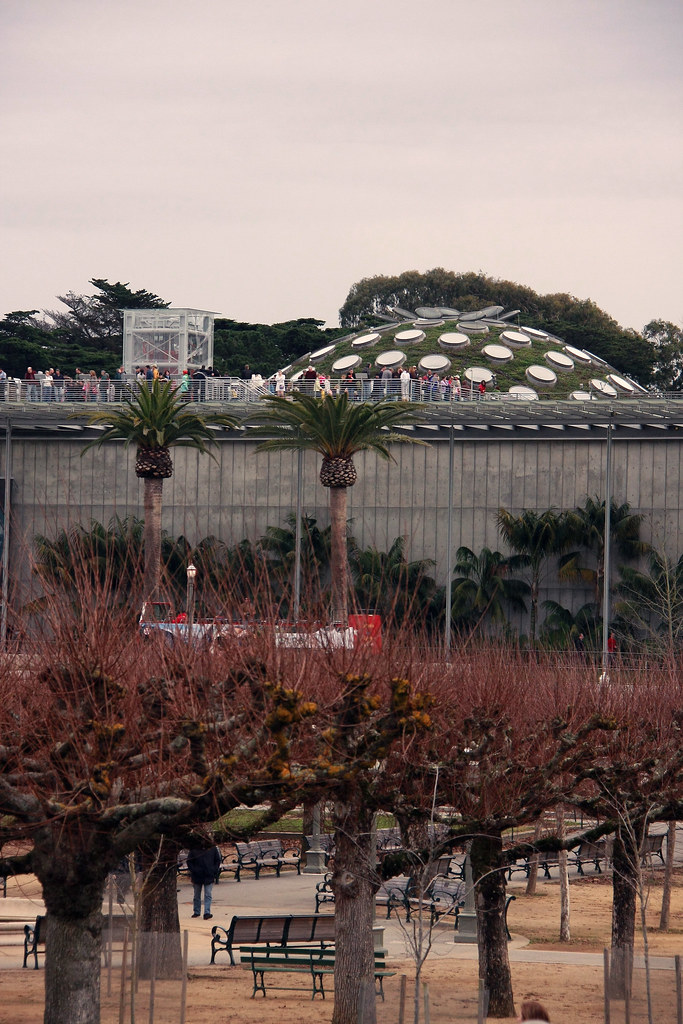
I walked in on a gray Tuesday morning — which, let’s be honest, describes most San Francisco mornings — and by the time I left four hours later, I had been through a tropical rainforest, watched the African savanna light cycle from dawn to dusk, toured a living coral reef, and sat inside a domed theater while the galaxy slowly rotated above my head. The Academy packs an aquarium, a natural history museum, a planetarium, and a research institution all under one remarkable living roof, which is itself planted with nearly 1.7 million native California plants. On clear days, you can spot it from outside the park: a gentle green hillock that seems to have grown organically from the ground, designed by the architect Renzo Piano with the landscape in mind from the very first sketch.
The Osher Rainforest dome is the crown jewel for many visitors. You enter at the forest floor and spiral upward through three climate zones — lowland tropics, cloud forest, flooded Amazon basin — with free-flying butterflies drifting past your shoulders and poison dart frogs perched on leaves just inches from the glass. The humidity is real, the sounds are real, and the plants are very much alive. It takes about twenty minutes to make the full ascent, and most people do it twice.
Below ground, the Steinhart Aquarium is equally arresting. The Philippine Coral Reef tank is one of the deepest living coral reef exhibits in the world, a 212,000-gallon cylinder teeming with reef sharks, moray eels, and schools of fish moving like liquid color. The planetarium shows rotate regularly and sell out fast, so booking in advance is worth the extra two minutes of planning.
One thing that often surprises first-time visitors: the Academy is also a working research institution. Scientists based here are actively discovering new species and publishing peer-reviewed work. The exhibits are not static displays — they reflect genuine, ongoing science, which gives the whole visit a sense of intellectual aliveness you rarely feel in a traditional museum setting.
The Academy sits at 55 Music Concourse Drive, directly across the plaza from the de Young Museum. Parking in Golden Gate Park can be a puzzle, so the N-Judah Muni line is a genuinely easy option that drops you a short walk away. General admission runs around $35 to $40 for adults, with discounts for children, seniors, and San Francisco residents on select Sundays. Thursday evenings bring NightLife, an adults-only event with cocktails, live music, and the full run of exhibits — one of the more inventive date nights this city has to offer.
San Francisco has no shortage of remarkable places, but the California Academy of Sciences earns a special category all its own. It is curious, alive, endlessly surprising, and it will make you feel — at any age — like the world is bigger and stranger and more worth protecting than you remembered. That alone is worth the trip.