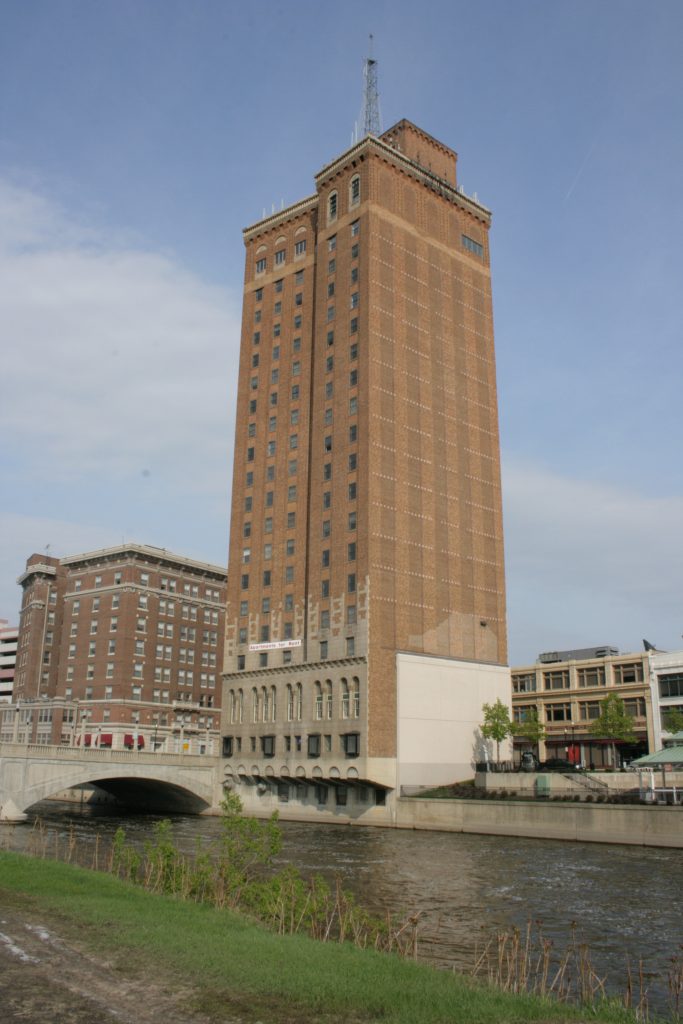
There are buildings that simply hold space on a street, and then there are buildings that stop you cold on the sidewalk and make you tilt your head back in pure admiration. Leland Tower, rising seventeen stories above downtown Aurora’s Stolp Island, is firmly in the second category. Built in 1928 and standing as the tallest building in Illinois outside of Chicago for a stretch of time, this Art Deco masterpiece is one of the most quietly astonishing architectural landmarks in the entire state — and most people outside of Aurora have never even heard of it.
I first encountered Leland Tower on a crisp October morning, walking along the Fox River after breakfast. The building announces itself gradually — first the terracotta crown peeking above the rooftops, then the full shaft of buff brick and ornamental detail coming into view as you round the corner onto Galena Boulevard. The tower has that particular 1920s confidence about it, the kind of design that says a city believed in its own future. Aurora was booming then, riding a wave of manufacturing prosperity, and Leland Tower was the city’s exclamation point.
What makes visiting worth your time today is not just the exterior spectacle, though that alone is worth the trip. The building has been thoughtfully restored and converted into residential apartments, and the ground-level lobby retains stunning original details — geometric terrazzo floors, brass fixtures, and decorative plasterwork that transport you directly back to the Jazz Age. Stand in that lobby and it takes genuine effort to remember what decade you are actually standing in.
The tower sits in Aurora’s downtown historic district, right in the middle of a very walkable stretch along the Fox River. A visit pairs naturally with a stroll across the footbridge to Stolp Island, where you get arguably the finest view of the tower’s full profile reflected in the water on a calm day. Bring a decent camera. Seriously. The late afternoon light hits the terracotta crown in a way that photographers absolutely love.
Architecture enthusiasts will want to linger and study the building’s stylistic details — the setbacks, the decorative band courses, the way the building tapers as it rises. It is a textbook example of the transitional period between Beaux-Arts grandeur and full Art Deco geometry, executed with remarkable craft by the architectural firm Rapp and Rapp, better known for their grand movie palaces.
Downtown Aurora has been investing seriously in its riverfront and historic core in recent years, and Leland Tower stands as the anchor of that story. After you have had your fill of admiring the exterior, the surrounding blocks offer coffee shops, galleries, and the kind of locally owned lunch spots that make a weekday afternoon feel genuinely civilized. The tower is not a ticketed attraction or a museum — it is simply a magnificent piece of American architectural history sitting right there on the street, available to anyone willing to show up and look up.
That accessibility is actually part of what makes Leland Tower so special. No admission fee, no reservation required. Just a short drive from the I-88 corridor, easy parking nearby, and one of the most photogenic skylines in the Chicago suburbs waiting for you. Come on a weekday morning when the streets are quiet and the light is soft, and you will have the full experience almost entirely to yourself. Aurora earned its nickname as the City of Lights, and Leland Tower — glowing gold in the right conditions — makes that title feel completely deserved.