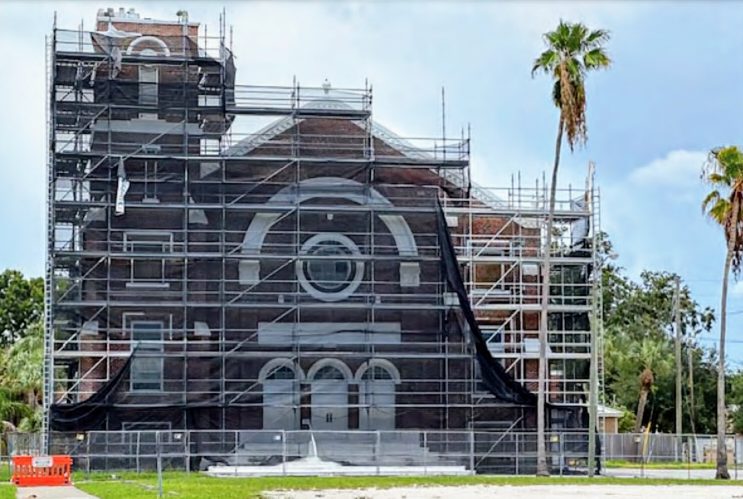
When Noam and Irene Krasniansky bought the long‑vacant Euclid Methodist Church in St. Petersburg in 2023, they envisioned restoring the nearly century‑old landmark as a community gathering place. Three years later, the couple’s nonprofit, Treehouse Sanctuary, Inc., has filed a federal lawsuit claiming the city unlawfully barred them from holding worship services.
Legal complaint alleges constitutional violations
The 30‑page complaint, filed in the U.S. District Court for the Middle District of Florida on Oct. 12, asserts that the City of St. Petersburg violated the First Amendment’s Free Exercise Clause, the Fourteenth Amendment’s Equal Protection Clause, the federal Religious Land Use and Institutionalized Persons Act (RLUIPA), and Florida’s Religious Freedom Restoration Act. The suit seeks declaratory and injunctive relief so Treehouse Sanctuary can resume worship, weddings, faith‑based gatherings and community events.
City’s fire‑safety requirements at the center of the dispute
According to the complaint, city officials determined that the removal of fixed sanctuary seating, basement partitions and ceiling finishes constituted “significant modifications” requiring a change‑of‑use review and additional fire‑safety improvements, including an automatic sprinkler system and a voice‑alarm system. The nonprofit argues those upgrades would demand extensive structural work, impose substantial costs and risk damage to the historic interior.
Treehouse Sanctuary’s architect proposed alternative life‑safety measures in February 2026, but the city rejected the waiver request in March. The lawsuit does not dispute the importance of fire safety; it challenges whether the city can condition religious worship on those particular improvements.
History of the property and prior redevelopment attempts
Built in 1926 at 919 10th Avenue N., the church once drew about 1,250 worshippers to its opening Thanksgiving service. After decades of disuse, a 2019 proposal to convert the building into roughly 20 residential units received city approval but was abandoned amid neighborhood opposition.
The Krasnianskys purchased the property for about $1.1 million, planning an event venue called “Treehouse” that would preserve the historic architecture while generating revenue for restoration. Their proposal faced opposition over parking, noise and compatibility with the surrounding neighborhood. The Community Planning and Preservation Commission deadlocked 3‑3 in November 2024, and the City Council split 4‑4 in February 2025, leaving the plan denied.
From event venue to interfaith sanctuary
After the commercial proposal stalled, the couple established Treehouse Sanctuary as an interfaith religious organization, reopening the building for worship in August 2025. A celebratory gathering of roughly 120 young adults drew complaints, though police found no noise violations and emergency responders reported no medical emergencies despite claims that eight people fainted. The following day, about 500 people attended a community market held on the premises.
By September 2025, the St. Petersburg Fire Department ordered the property closed. The nonprofit maintains that flexible seating is essential to accommodate different religious traditions and that removing chairs did not alter the building’s fundamental use as a place of worship.
Comparisons and broader implications
The plaintiffs point to other local churches—Allendale United Methodist, St. Pete First United Methodist, and First Baptist—that operate with flexible seating or host secular events without facing comparable fire‑safety demands. They argue the city’s enforcement unfairly targets their religious use.
Krasniansky likened the city’s shifting requirements to a mechanic repeatedly changing the conditions for using a car, saying, “If you buy a car, and someone suddenly says, ‘You cannot use the car because the PSI in your tires is too low.’ Then they change the PSI, then they say, ‘Actually it’s not the tires, it’s the hubcaps.’ I want my rights back.” He emphasized that the dispute is about constitutional religious liberty, not personal preference.
Next steps
The lawsuit seeks a court order allowing Treehouse Sanctuary to resume worship and related activities while striking down the city’s change‑of‑use and fire‑safety conditions as unconstitutional. The city’s full legal response has not yet been made public.
Original reporting: St. Pete Catalyst — read the source article.