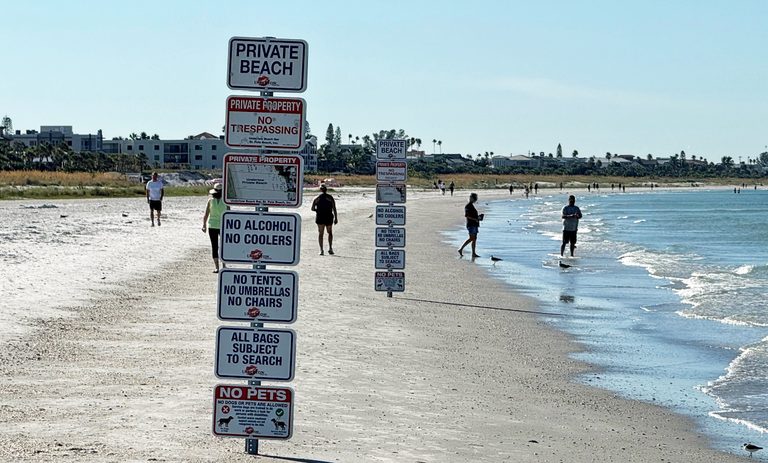
St. Pete Beach City Commission approved new restrictions on beach signs, creating a 50-foot buffer that prohibits permanent stakes, poles and similar sign structures near the Gulf. The ordinance still allows removable A-frame signs outside the restricted area under specific conditions.
Public Beach Access and Private Property Rights
The debate centers on Florida’s customary use doctrine, which recognizes that the public may establish the right to continue using privately owned dry sand beaches if that use has historically been ancient, reasonable, uninterrupted and free from dispute. Supporters of the ordinance argued private beach signs have become an attempt to discourage those historic rights.
Commissioner Karen Marriott said the ordinance reflects growing pressure on a beach that has changed significantly in recent years. “For decades, people were pretty good at getting along,” Marriott said. “Today, more people are shoved into the same amount of space. There starts to be a little bit of friction.”
Property owners offered a sharply different perspective. Plaza Beach Hotel owner Rob Czyszczon rejected the notion that beachfront businesses are attempting to keep people off the shoreline. “We are not telling anybody they cannot walk the beach,” Czyszczon said. “We just don’t want you parking on the beach and staying on private property.”
Attorney Alyssa Gagnon, representing beachfront property owners, argued the ordinance is “vague and overbroad” and raises First Amendment concerns. Environmental concerns also factored into the discussion, with St. Pete Beach City Attorney Ralf Brookes citing research suggesting exposed posts can interfere with sea turtle nesting.
Original reporting: St. Pete Catalyst — read the source article.