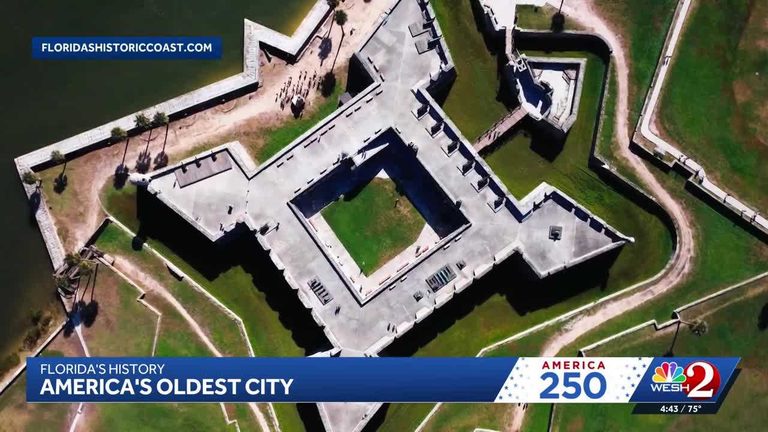
As the United States celebrates its 250th birthday, a city in Florida is much older. St. Augustine was first discovered more than 350 years ago and has helped define the United States. The city is home to one of the country’s oldest and most unique forts, the Castillo de San Marcos, which was founded by the Spanish in 1672.
History of St. Augustine
Across the road from the fort is St. George Street, lined with shops and homes built by the Spanish. Families of soldiers lived there. The Spanish occupied the area until the 1760s when the British came in. While St. Augustine was not part of the 13 original colonies, it was the 14th and 15th, if you think of East and West British Florida.
When the original 13 separated in the American Revolution, St. Augustine remained loyal to the crown. Spanish explorer Ponce de Leon first discovered America in 1513, landing on what is now the Fountain of Youth Archaeological Park. The park was a botanical garden started by an English botanist by the last name of Williams, and he had a well here that he sold water for a small price.
Fort Mose
Another important part of St. Augustine’s history is Fort Mose, which was established in 1738 as the first free African American settlement in the United States. Today, you can walk the grounds where a recreated fort stands on the national park site. In order to stay, the Spanish required the African Americans to become Catholic and helped defend the town. They created the Black Militia.
Original reporting: WESH Orlando — read the source article.