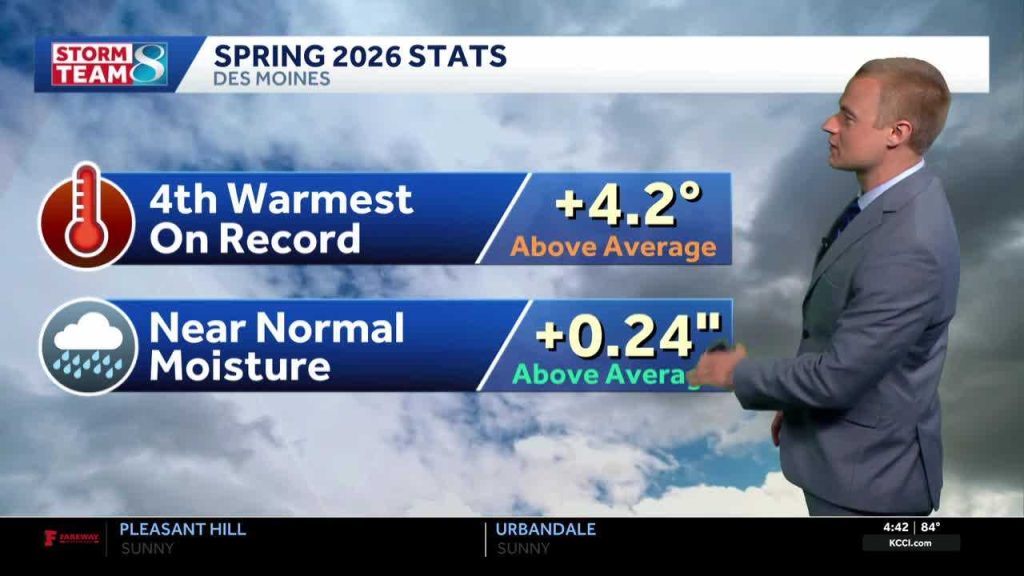
As meteorological spring concludes with the arrival of June, Des Moines residents reflect on one of the warmest springs in the city’s history. Spring 2026 ranks as the fourth warmest on record, with an average temperature of 55.2 degrees, surpassing the normal average of 51 degrees by more than 4 degrees.
Historical Context
Des Moines has been recording weather data since the 1870s, and the spring of 2026 stands out as particularly warm. The top three warmest springs in the city’s history were in 2012, 1977, and 2024, with average temperatures of 60.1, 57.5, and 55.3 degrees, respectively. This year’s spring joins these ranks, highlighting a trend of increasing temperatures in recent years.
Rainfall Variability Across Iowa
While temperatures were consistently high, rainfall across Iowa varied significantly. Northwest Iowa experienced a shortfall of about two inches of moisture from March through May, indicating drier conditions. In contrast, southern Iowa faced heavy thunderstorms, resulting in above-average precipitation levels. Des Moines itself recorded 11.67 inches of rain and melted snow, slightly exceeding the norm.
Understanding Meteorological Seasons
It’s important to distinguish between meteorological and astronomical seasons. Meteorological seasons, which are used for recordkeeping, align with calendar months: spring spans March to May, summer June to August, fall September to November, and winter December to February. Meanwhile, astronomical seasons are based on equinoxes and solstices, with spring continuing until the summer solstice on June 21.
As Des Moines residents prepare for the summer months, the warm spring serves as a reminder of the changing climate patterns that impact local weather conditions.
Original reporting: KCCI Des Moines — read the source article.