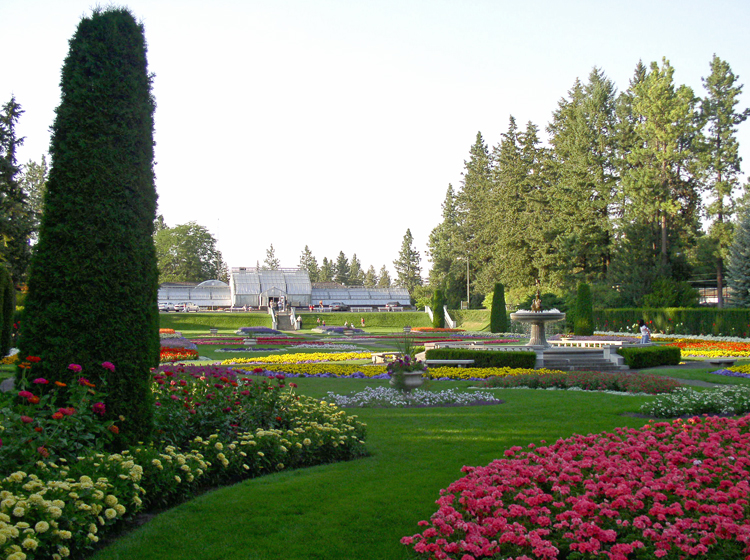
There’s a moment, usually sometime in late June, when you round the corner past the rose hill at Manito Park and the Duncan Garden opens up in front of you — and you stop walking. Not because you’re tired, but because the symmetry of it, the color, the sheer deliberate beauty of the place, genuinely takes your breath away. It happened to me on my first visit, and if I’m being straightforward with you, it happens every single time.
Manito Park sits in Spokane’s South Hill neighborhood, roughly ten minutes from downtown, and it has anchored this part of the city since 1904. The park itself covers about 90 acres and includes a Japanese garden, a lilac garden, a duck pond, and greenhouse conservatory — but the crown jewel is the Duncan Garden, a formal European-style garden laid out in the French Renaissance tradition. Think crisp geometric beds, manicured hedges clipped to a ruler’s edge, and tens of thousands of annual flowers replanted each season in patterns that shift year to year. Gardeners from the City of Spokane’s parks department put in staggering work to keep this place looking the way it does, and it shows in every perfectly edged border.
The garden is free to visit. Read that again: completely free. You can spend two hours here on a summer afternoon, wandering the gravel paths, photographing the fountain at the center, watching bees work their way through the blooms, and it won’t cost you a dime. That feels almost radical in 2024, and it’s one of the reasons locals guard this place with a kind of quiet civic pride.
What makes Duncan Garden genuinely special beyond its visual drama is the sense of occasion it creates without requiring one. Couples come here for engagement photos. Families spread out on the grass nearby for picnics. Older residents walk the paths at a measured pace, clearly longtime regulars. First-time visitors wander slowly with their phones out, trying to do justice to something that honestly resists being captured in a single frame. Everyone coexists easily, and the atmosphere is unhurried in a way that feels increasingly rare.
If you time your visit for peak bloom — typically late May through early September — the effect is genuinely spectacular. The park is also worth a visit in early spring when the lilac garden erupts, usually around Mother’s Day weekend, drawing crowds from across the Inland Northwest for the city’s annual Lilac Festival.
Plan to arrive in the morning on weekdays if you want the garden at its quietest. Bring a coffee from one of the nearby South Hill cafés, find a bench near the central fountain, and just sit with it for a while. Spokane has a lot going for it, but this particular patch of the city — tended with obvious care, open to everyone, beautiful in a way that feels almost old-fashioned — is something you won’t forget.